
How to get useful feedback at the end of a workshop
By the Workshopy teamPublished 5 min read
Ask for feedback before people leave, in the last five minutes of the session, not in an email the next day. Ask two or three specific questions (what was useful, what you would change, how useful it will be for their work) instead of a long satisfaction form. Then read the answers for patterns, and start the next session by saying what you changed because of them.
Ask before people leave
Feedback you ask for after the session mostly doesn't arrive. The Carpentries' instructor training puts it plainly: learners are much more likely to fill out the survey while they are still at the workshop than after they leave. Their advice is to give the time for it at the end, rather than fitting in another fifteen minutes of teaching.
So plan the last five minutes as part of the session. Put the questions on the screen, say why you're asking, and wait while people answer. If the workshop runs over, cut the last exercise, not the feedback.
Ask during the workshop too
End-of-day feedback tells you how to improve the next workshop. Feedback before a break tells you how to improve this one, while the same people are still in the room.
Greg Wilson describes a simple version, the minute card: before each break, every learner writes one thing that was useful and one thing that was too fast, too slow, confusing or irrelevant. Reading them over coffee takes less than five minutes for a class of 40, and it shows you what to explain again after the break. The Carpentries add one rule: don't comment on the feedback while you collect it, and open the next part of the session by addressing what came up most often.
Ask fewer, more specific questions
A long form gets short answers. Decide which questions you would actually act on, and drop the rest. Wilson notes that "What do you think?" is much harder to answer than "Was I speaking too quickly?", and the specific question is also the one that tells you what to fix.
Three or four questions are enough for most workshops:
- What is one thing from today you'll use in your own work? (open)
- What is one thing you would change? (open)
- How useful will today be for your work? Very useful / Somewhat / Not really
- How was the pace? Too slow / About right / Too fast
Write each one with survey basics in mind. The Pew Research Center advises asking one thing per question (not "Was the session clear and useful?") and offering a choice between alternatives rather than a statement to agree with, because some people tend to agree with whatever statement they are given. Put the open questions first: answers to an open question drift toward whatever the closed questions before it mentioned.
Ask about usefulness, not enjoyment
"Did you enjoy the session?" measures mood. People enjoy a friendly teacher, good coffee and an early finish, and none of that tells you whether they can now do the thing you taught.
A meta-analysis of training studies by George Alliger and colleagues separated two kinds of reaction: how much people liked the training and how useful they judged it. The usefulness ratings were the ones more strongly related to what people learned and to what they did back at work. If you ask only one rating question, make it about usefulness.
Read the answers for patterns
One comment is one person's view. The same point from five people is a pattern worth acting on.
- Sort the open answers into a few themes (pace, setup, a confusing step, too much theory) and count each one.
- Put the numbers next to what happened. If a third of the room says the pace was too fast and the same third got stuck on the same step, you know where to slow down.
- Ask someone else to read them first if the comments sting. Wilson suggests a colleague who summarises the feedback for you, so you see the pattern before the one harsh sentence.
Close the loop
People give better feedback when they can see it is used. The Carpentries recommend telling learners explicitly what you are changing because of their feedback, which encourages them to keep giving useful answers. At the start of the next session, or in the follow-up email, say two things you changed and one thing you decided to keep, and why.
Collecting feedback in Workshopy
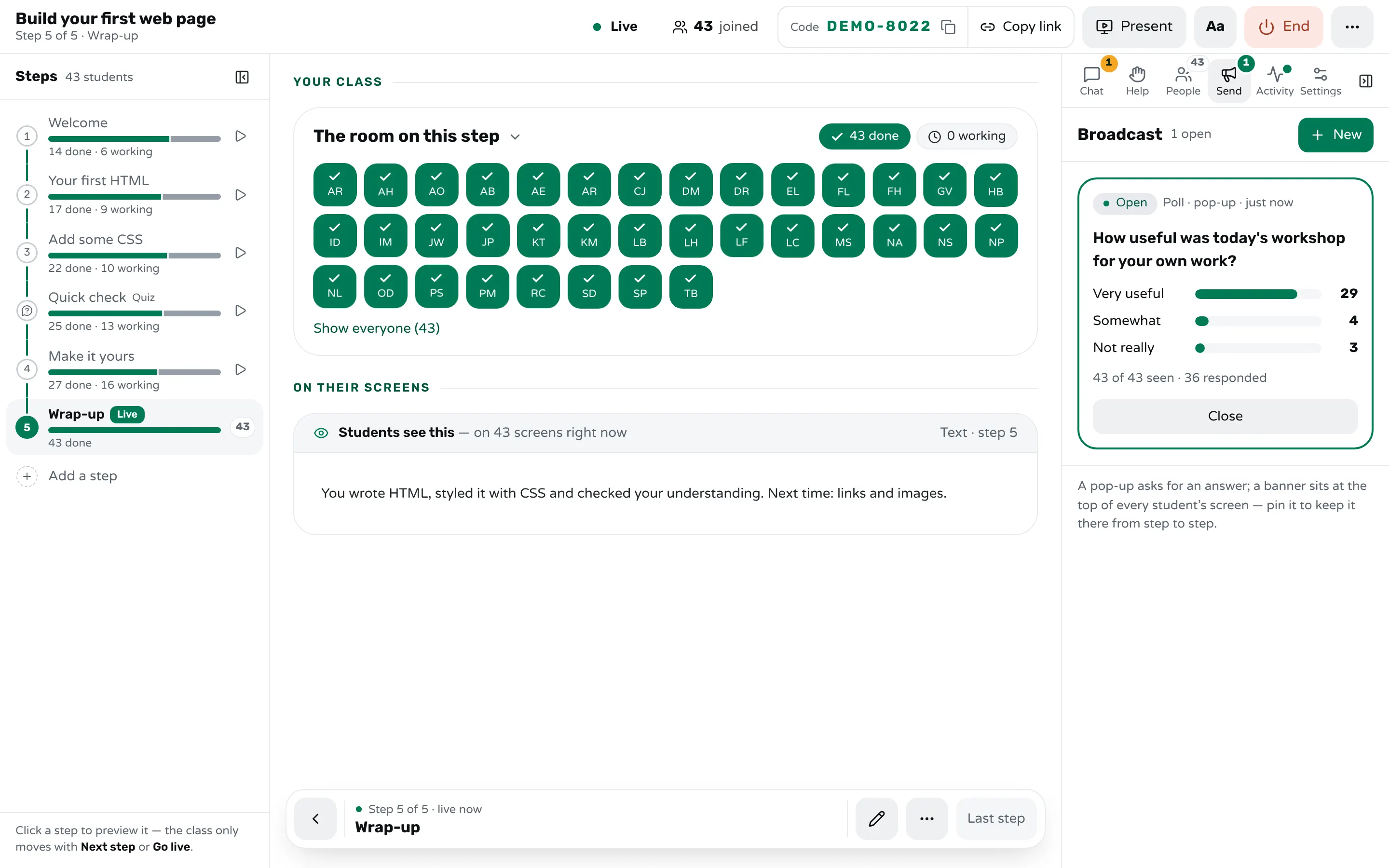
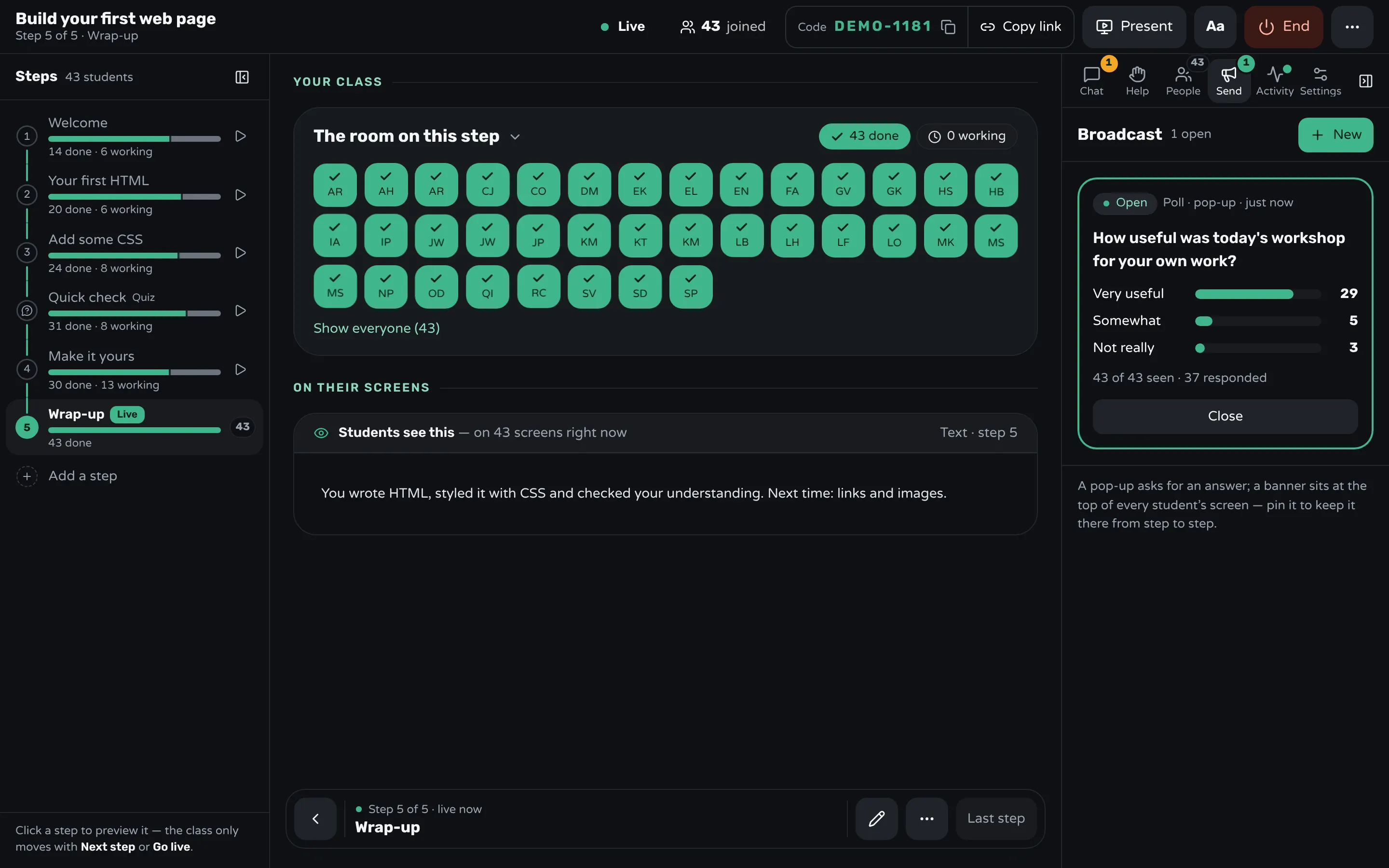
On the last step, open Send in the console beside the room, press New, write your question, set Students answer to One choice and add the answers. It pops up on every student's screen, or sits as a banner across the top, and the panel counts each answer as it arrives, along with how many students have seen it. The answers stay in the class's report under Polls & quizzes.
The report also shows what students did, not only what they said: how many finished each step, where they got stuck and how long they waited for help. Read the feedback next to it. For written comments you want to keep anonymous, use a separate form: Workshopy's chat and private messages carry the student's name.
Sources
- The Carpentries Instructor Training: Building Skill With Feedback
- Greg Wilson, Teaching Tech Together (2019): Sticky notes
- George Alliger, Scott Tannenbaum, Winston Bennett, Holly Traver and Allison Shotland, A meta-analysis of the relations among training criteria (Personnel Psychology, 1997)
- Pew Research Center: Writing survey questions
Frequently asked questions
How many questions should a workshop feedback form have?
As few as you will act on, usually three or four. A minute card during the day is two prompts: one thing that helped, one thing that didn't.
Should workshop feedback be anonymous?
For written comments, yes: the Carpentries recommend private, anonymous feedback, because a public board gets different and less useful answers. A spoken round of one good thing and one thing to change can be done by name.
When should I send the feedback survey?
Don't send it: ask for it in the room, in the last five minutes, before people leave. Fewer people answer once they have left.
What is the single most useful feedback question?
"What is one thing you would change?" It gets a concrete answer, and the same answer from several people tells you exactly what to fix.
Should I use a 1 to 5 rating?
One rating question is fine if it asks about usefulness for their work. Avoid a list of statements to agree or disagree with: some people lean toward agreeing, whatever the statement says.
Keep reading
How to check for understanding without stopping the class
Ask one question everyone answers at once, write it so wrong answers show the mistake, and decide in a minute what to teach next.
7 min read · 20 Oct 2026
Run a live classHow to measure whether a training session worked
Decide what people should be able to do, measure it during the session and with a task at the end, and check weeks later if they use it.
5 min read · 21 Oct 2026
Hands-on & coding workshopsHow to run a hands-on coding workshop
Plan short steps that each end in working code, write the code live and slowly, and keep a queue for students whose code won't run.
3 min read · 19 Oct 2026
See it with a class of 45. No sign-up.
The live demo runs the real product with a simulated class. When you're ready, start free.