
How to measure whether a training session worked
By the Workshopy teamPublished 5 min read
Decide before the session what people should be able to do afterwards, and measure that. During the session, track who completes each exercise and where they get stuck. At the end, give a short task that uses the skill. Weeks later, check whether they use it at work. A satisfaction survey alone won't tell you: how much people liked a session says little about what they learned.
Start from what should change
Write down the result you want before you plan the session, then plan backwards from it. The Kirkpatrick model for evaluating training has four levels: reaction, learning, behavior and results. Kirkpatrick Partners insist on starting with the last one, the result the training is for, and working back to the behavior that produces it.
Make the goal something you could watch someone do. "Understand pivot tables" is not measurable. "Builds a pivot table from the monthly sales export without help" is, and it tells you what the exercises and the final task should be.
Don't stop at the satisfaction survey
Most training is judged by a form handed out at the end. In 2003, Winfred Arthur and colleagues quoted an industry benchmarking survey in which 78% of the organizations measured reactions, against 32% that measured learning and 9% that measured behavior at work. Their review concluded there is very little reason to believe that whether trainees liked a program tells you much about what they learned or whether their work changed.
If you ask for reactions, ask the right one. A meta-analysis by George Alliger and colleagues found that ratings of how useful the training was were more strongly related to learning and to performance at work than ratings of how much people enjoyed it. Ask "How useful will this be in your work?", not "Did you enjoy it?". How to get useful feedback at the end of a workshop covers the rest of the form.
Measure during the session
The session itself produces the most direct evidence, if you collect it:
- Completion of each exercise. Who finished step 3, and how long it took them.
- Where people got stuck. The step with the most help requests is the step that needs rewriting, or the skill that needs more practice.
- Checks for understanding. A one-question quiz after each new idea shows what the room understood, while you can still re-explain it (how to check for understanding without stopping the class).
Kirkpatrick Partners make the same point about reactions: rather than waiting for a survey at the end, use quick checks during the program so you can correct course while it's running.
End with a task, not a recap
At the end, have everyone do the thing the session taught, on their own, with a result you can check: build the pivot table from a new file, write the query that answers a new question, fix a broken configuration. Arthur's review notes that learning is typically measured this way, with written and performance tests rather than self-ratings.
If you can, give a similar task at the start. The difference between the two is what the session added. Keep the final task short and new: an exercise copied from the session measures memory of that exercise, not the skill.
Check weeks later whether they use it
The real test happens back at work, and it usually looks worse than the end-of-session result. Arthur's meta-analysis found the effects of training on behavior noticeably smaller than its effects on learning, and gave one reason: people can't show a skill they never get the chance to use. So check that there is a chance. If nobody builds pivot tables in their job, the session can't change how they work.
Two practical rules for the follow-up:
- Ask a few weeks later, about specific use. "In the last two weeks, have you built a pivot table at work? What stopped you?"
- Don't rely only on the learner's own report. A meta-analysis of transfer studies by Brian Blume and colleagues found that results collected from the same source in the same setting consistently looked stronger than they were. Ask the manager, or look at the work itself.
Measuring a session in Workshopy
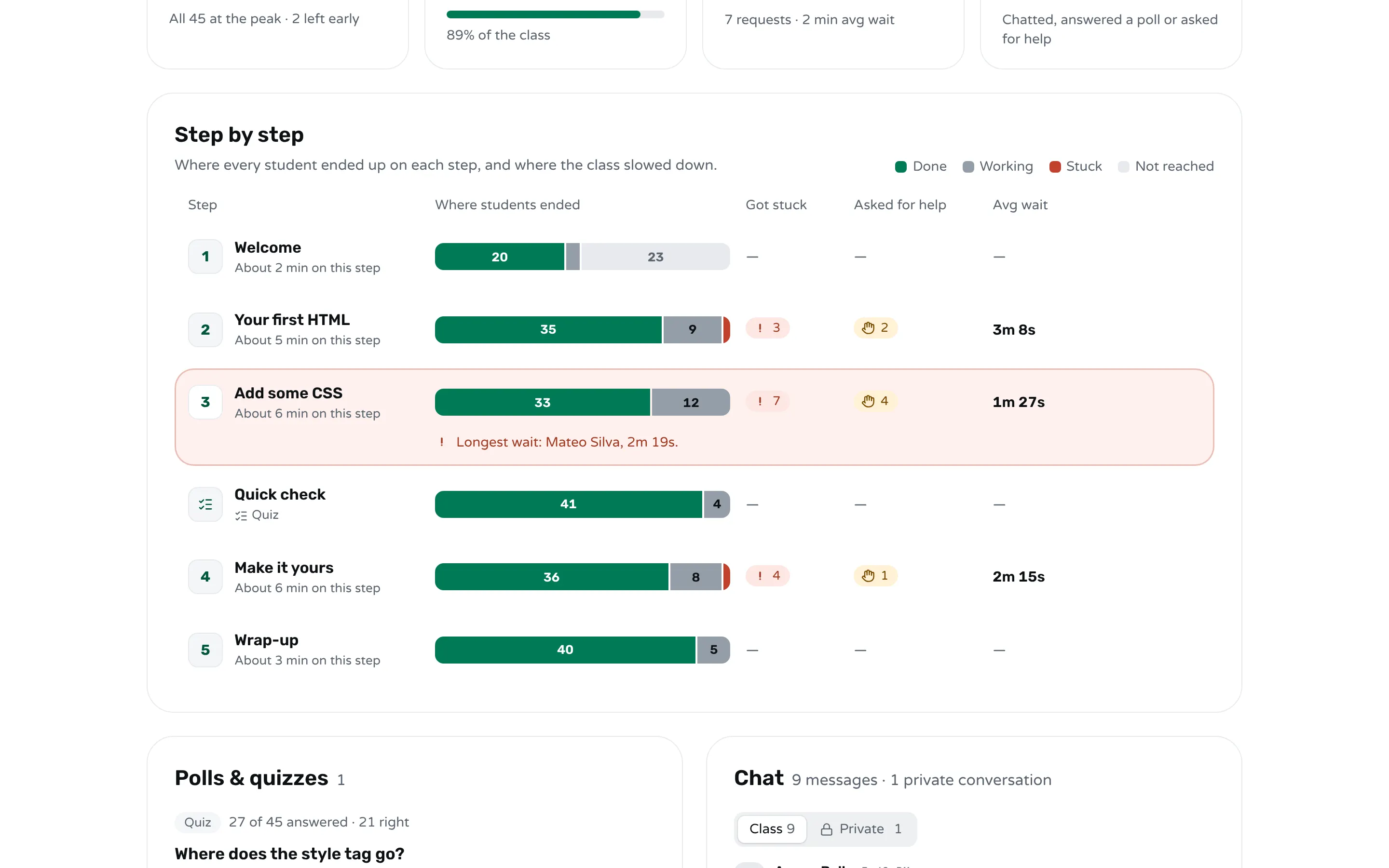
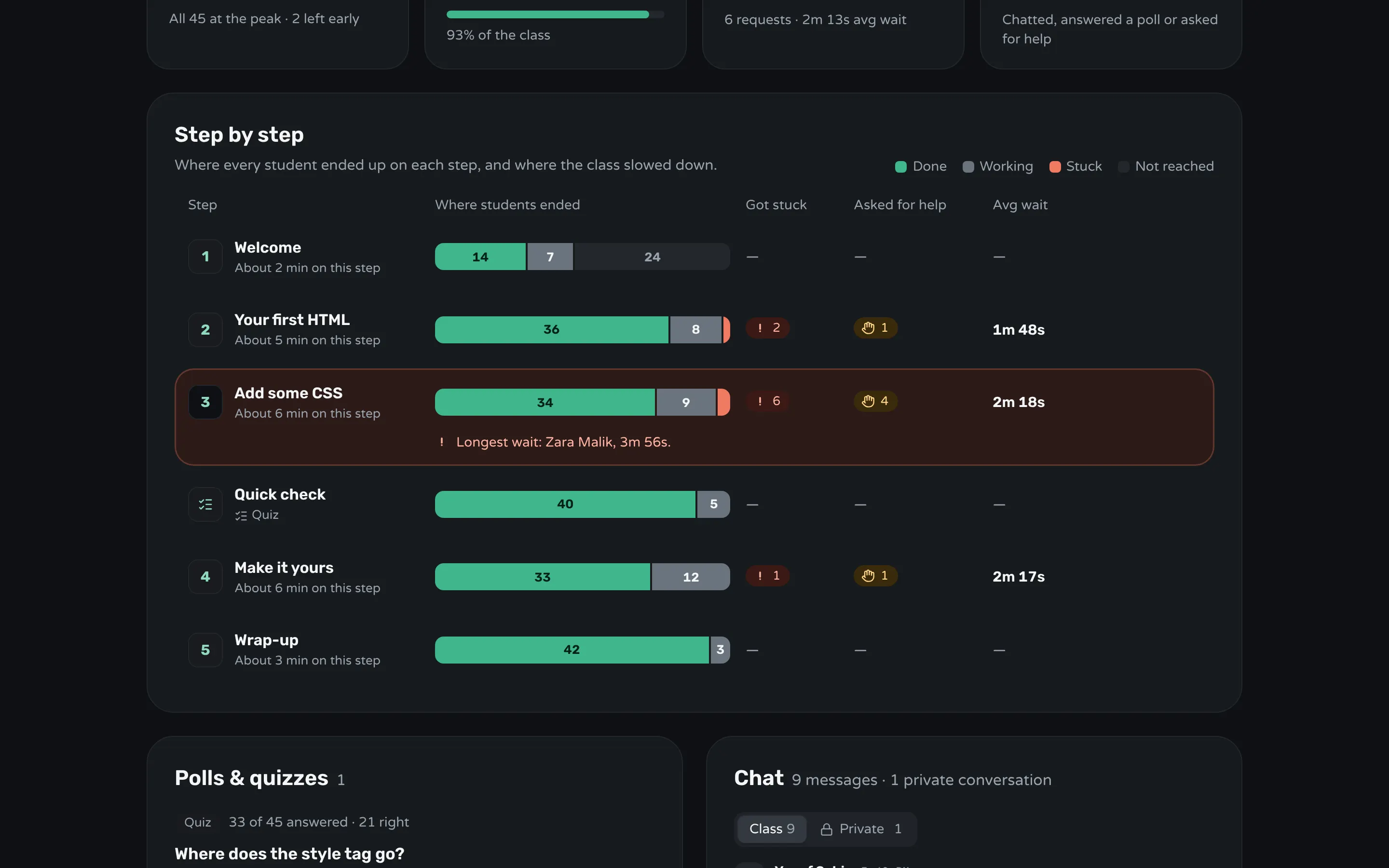
When the class ends, Workshopy builds its report. A sentence at the top says how many finished every step and which step the class got stuck on, and the Step by step table shows, for every step, how many students finished it, how many got stuck, how many asked for help and how long they waited. The Polls & quizzes card shows how many answered each quiz question and how many got it right, and the report exports as CSV or Markdown.
Run the same template with the next group and the Reports list shows each class with the share of students who finished every step, so you can see whether a rewritten step made a difference. What happens back at work is outside Workshopy: that part of the measurement is the follow-up above.
Sources
- Kirkpatrick Partners: The Kirkpatrick Model
- Winfred Arthur, Winston Bennett, Pamela Edens and Suzanne Bell, Effectiveness of training in organizations: a meta-analysis of design and evaluation features (Journal of Applied Psychology, 2003)
- George Alliger, Scott Tannenbaum, Winston Bennett, Holly Traver and Allison Shotland, A meta-analysis of the relations among training criteria (Personnel Psychology, 1997)
- Brian Blume, Kevin Ford, Timothy Baldwin and Jason Huang, Transfer of training: a meta-analytic review (Journal of Management, 2010)
Frequently asked questions
What are the four levels of the Kirkpatrick model?
Reaction (how participants felt about it), learning (what they can now do), behavior (whether they do it at work) and results (whether it changed the outcome the training was for). Plan from results backwards, and measure from reaction forwards.
Is a satisfaction survey enough to measure training?
No. Whether people liked a session tells you little about what they learned. Keep one question about how useful it was, and measure learning with a task.
How soon after a training session should I measure behavior?
When people have had a real chance to use the skill, which depends on the job: a skill used daily can be checked after a week or two, one used monthly needs longer. Ask about specific recent use.
How do I measure training on software skills?
Give a short task in the software at the end, such as a file to clean, a query to write or a report to build, and check the result. During the session, track who completes each exercise and where they get stuck.
What if most people finish the session but don't use the skill at work?
Look at the chance to use it first: whether their work calls for the skill, and whether they have the access and time to use it. The training may have worked; the job may not ask for it.
Keep reading
How to get useful feedback at the end of a workshop
Ask before people leave, ask a few specific questions about usefulness, read the answers for patterns, and tell the next group what changed.
5 min read · 21 Oct 2026
See who's stuckHow to check for understanding without stopping the class
Ask one question everyone answers at once, write it so wrong answers show the mistake, and decide in a minute what to teach next.
7 min read · 20 Oct 2026
See who's stuckHow to tell which students are stuck in a hands-on class
Stuck students rarely raise a hand. Give every step a done signal, look for who hasn't sent it, and help the right student first.
3 min read · 19 Oct 2026
See it with a class of 45. No sign-up.
The live demo runs the real product with a simulated class. When you're ready, start free.