OtherEN
Intro to Git — Snapshots, Branches & Sharing
 WorkshopyOfficial
10 stepsQuiz9 interactiveDiagram~65 min
gitversion controlbeginners
Used by 1 teacherBeginner
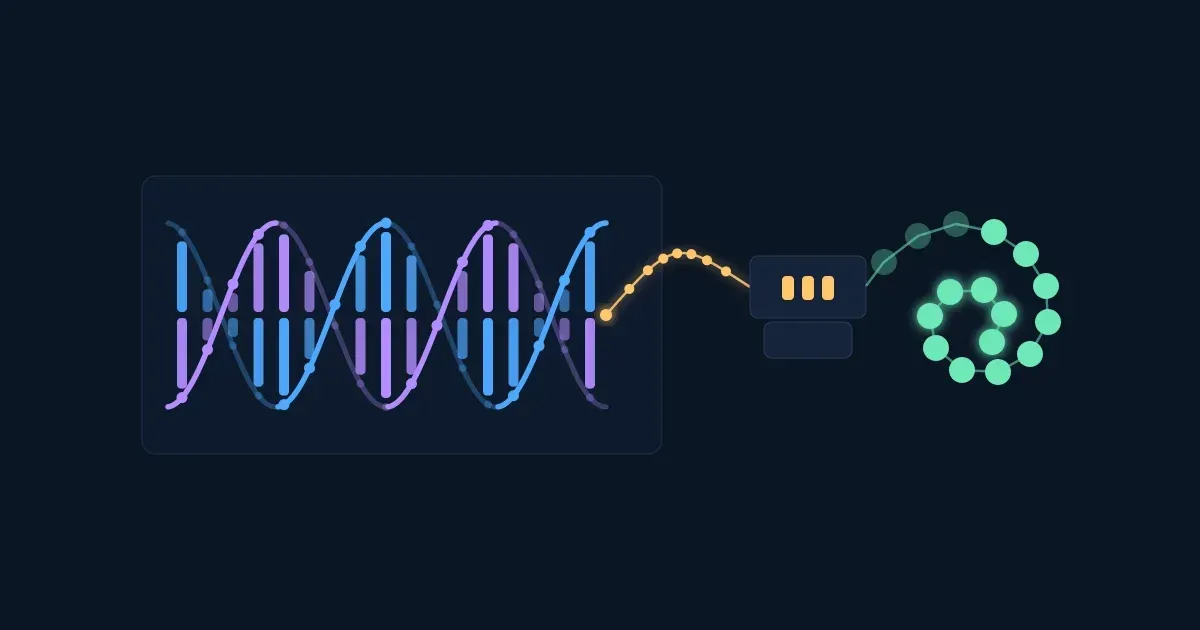
What is DNA? Learn from zero how DNA works: its four-letter code, genes and proteins, how it copies itself and what you inherit, with animations to play with.
WorkshopyOfficial
37 lessons · used by 2 teachers
Sign in to copy it to your workspace. It’s free.
13 steps · 2 quizzes · about 60 minutes · open any step, or read it here
In this lesson you learn what DNA is, what it does in your body and how it works, starting from zero. DNA is the instruction book inside your cells: a very long molecule that carries the instructions for building and running a living thing.
Every plant, animal, mushroom and bacterium has DNA. Yours came from your parents, and it is part of the reason you have your eye colour, your blood type and much more.
Below is a small piece of DNA. It looks like a twisted ladder. Spin it, unzip it and look at the letters on the rungs.
Interactive · A double helix, up close — try it in the lesson
In this lesson you'll:
It takes about 60 minutes. Each step has an animation to play with, and each one uses what you learned in the step before.
Takeaway: DNA is a long, twisted ladder of letter pairs that holds the instructions for building you.
Your body is not one solid thing. It is built from tiny living units called cells, about 30 trillion of them, and each one is far too small to see by eye.
Most cells have a control centre called the nucleus. Inside it is your DNA, split into pieces called chromosomes. Almost every cell in your body carries a full copy of your DNA: a skin cell has the same DNA as a muscle cell.
Try it: zoom in from your whole body, one level at a time, and read the size at each level.
Interactive · Zoom from your body to your DNA — try it in the lesson
If a skin cell and a nerve cell carry the same DNA, why are they so different? Each kind of cell uses different parts of the instructions, like two cooks using different recipes from the same cookbook.
Takeaway: your DNA sits in the nucleus of almost every cell, packed into 46 chromosomes.
Zoom right in and DNA turns out to be a chain of small building blocks called nucleotides. Each one has three parts: a phosphate, a sugar and a base. The phosphates and sugars link up into a long chain, the backbone. The bases stick out from it, and they come in only four kinds:
| Letter | Base |
|---|---|
| A | adenine |
| T | thymine |
| G | guanine |
| C | cytosine |
The order of the bases along the chain is the code, the way the order of letters in a sentence carries its meaning. ATGC and CGTA use the same four letters but say different things.
Try it: build a chain with the letter buttons. Watch how many different messages a chain of that length could spell.
Interactive · Write with four letters — try it in the lesson
With only four letters, a chain of 10 can be arranged in more than a million ways. Your DNA has about 3 billion letters in each set, and you have two sets, one from each parent. That's about 6 billion letters in a single cell.
Takeaway: DNA's information is the order of its four bases: A, T, G and C.
DNA has two chains side by side, joined through their bases like the two halves of a zip. And the bases don't join just any partner:
Why? It comes down to their shapes and the weak links between them (chemists call them hydrogen bonds). A and G are larger bases; T and C are smaller. Every pair is one large and one small base, so every rung of the ladder is the same width. A and T hold on with 2 weak links; G and C with 3.
Try it: build the partner strand. Pick the letter that fits each piece, then try a wrong one to see why it doesn't fit.
Interactive · Find the partner: A with T, G with C — try it in the lesson
Because the rule never changes, one strand tells you the other. If one side reads ATGC, the other side must read TACG. DNA uses exactly this trick to copy itself, as you'll see later in the lesson.
Takeaway: A pairs with T and G pairs with C, so each strand is a pattern for the other.
Put the two strands together and you get a ladder: the sugar-phosphate backbones are its sides and the base pairs are its rungs. Then the whole ladder twists, like a rope ladder turned around and around. This shape is called the double helix; "helix" means spiral.
Try it: drag the Twist slider from 0% to 100%, then spin the result.
Interactive · From ladder to double helix — try it in the lesson
The twist makes DNA compact and keeps the bases tucked inside the spiral, protected. One full turn takes about 10 base pairs, and the whole spiral is only 2 nanometres wide.
The shape was worked out in 1953 by James Watson and Francis Crick, using X-ray images of DNA from Rosalind Franklin's lab.
Takeaway: DNA is a double helix: a ladder of base pairs twisted into a spiral.
Here is a surprise. If you took the DNA out of just one of your cells and stretched it out, it would be about 2 metres long. Yet the nucleus it lives in is only about 0.006 mm across.
DNA fits because it is wound and folded, again and again:
Try it: press Next to pack the thread, one stage at a time.
Interactive · Packing 2 metres of DNA into one cell — try it in the lesson
Each of your cells has 46 chromosomes, in 23 pairs. Each chromosome is one very long DNA molecule, packed tight.
Takeaway: about 2 metres of DNA fits in a cell because it is wound around histones and folded into chromosomes.
Four questions on what you have learned so far.
Question 1. Where in a cell is most of your DNA kept?
Question 2. Which four letters make up DNA's code?
Question 3. One strand of DNA reads GATC. What does its partner strand read?
Question 4. How does about 2 metres of DNA fit inside a tiny nucleus?
So what are all these instructions for? Mostly, for making proteins. Proteins are the workers and building materials of your body: they carry oxygen in your blood, digest your food, build your hair and skin, and help fight germs.
A gene is a stretch of DNA that holds the recipe for one protein. Think of your DNA as a huge cookbook and each gene as one recipe in it. You have about 20,000 genes with protein recipes.
Try it: pick a gene to see the protein it makes and the job that protein does.
Interactive · Genes and the proteins they make — try it in the lesson
The protein recipes make up only about 1–2% of your DNA. Much of the rest helps decide when and where each gene is used, which is how a skin cell and a nerve cell, with the same DNA, end up so different.
Takeaway: a gene is a stretch of DNA with the recipe for one protein, and proteins do the work in your body.
Your DNA stays safe inside the nucleus, but proteins are built outside it. So the cell sends out a copy of just the gene it needs: a messenger molecule called RNA (messenger RNA, to be exact).
An enzyme called RNA polymerase opens a short section of DNA and reads one of its strands, the template. For each letter it adds the partner letter to a growing RNA chain, with one difference: RNA uses U (uracil) where DNA would use T.
| Template DNA | RNA |
|---|---|
| T | A |
| A | U |
| C | G |
| G | C |
This copying is called transcription. Try it: step the enzyme along the gene, watch the RNA grow, then send it out of the nucleus.
Interactive · Transcription: copying a gene into RNA — try it in the lesson
The finished RNA reads the same as the DNA's other strand, with U in place of every T. A cell can make many RNA copies of one gene, so it can build lots of the same protein quickly.
Takeaway: transcription copies a gene into RNA, using the pairing rule with U instead of T.
Outside the nucleus, the RNA reaches a ribosome, the cell's protein builder. The ribosome reads the RNA three letters at a time. Each group of three letters is a codon, and each codon stands for one amino acid: the beads a protein is made of.
At a stop codon the chain of amino acids is finished. It folds into a 3D shape, and that shape decides what the protein can do. This reading is called translation: from the language of letters into the language of proteins.
Try it: step the ribosome along the RNA you made in the last step. Then read the start of a real gene: hemoglobin-beta, part of the protein that carries oxygen in your blood.
Interactive · Translation: reading three letters at a time — try it in the lesson
Almost every living thing uses this same code, from bacteria to mushrooms to people. It is one of the strongest clues that all life on Earth is related.
Takeaway: a ribosome reads RNA in three-letter codons; each codon adds one amino acid until a stop codon ends the protein.
You started life as a single cell. Now you are about 30 trillion cells, and almost every one has a full copy of your DNA. So each time a cell divides, it must first copy all of its DNA.
The pairing rule makes this possible:
Try it: step the unzipping along and watch each half build a new partner.
Interactive · Replication: DNA copies itself — try it in the lesson
Cells copy their DNA with great care. They check their work as they go and fix most mistakes, so only about one letter in a billion ends up wrong.
Takeaway: DNA copies itself by unzipping; each strand is the pattern for a new partner strand.
Copying is very accurate, but not perfect, and DNA can also be damaged, for example by ultraviolet light from the sun. A change in DNA's letters is called a mutation.
What a one-letter change does depends on what the new codon means:
Try it: tap a letter at the start of the hemoglobin gene and change it. Then try the three examples.
Interactive · Mutations: change one letter — try it in the lesson
Most mutations make no difference, and a few are even useful. Over many generations, small changes like these are part of why living things differ from one another, and how they evolve.
Takeaway: a mutation is a change in DNA's letters; its effect depends on what the new codon means.
You have two sets of chromosomes: 23 came from your mother's egg cell and 23 from your father's sperm cell, so each pair has one from each. That's why you share features with both parents.
Each parent passes on only one chromosome of each pair, chosen at random. So brothers and sisters, apart from identical twins, get different mixes from the same parents.
Try it: make a child, then a brother or sister, and compare their chromosomes.
Interactive · Half from each parent — try it in the lesson
For all this mixing, any two people share about 99.9% of their DNA. The remaining 0.1%, a few million letters, is part of what makes each person unique, together with how they grow up and live.
Takeaway: you get one chromosome of each pair from each parent, picked at random, which makes every child a new mix.
Use the rules from this lesson: A pairs with T, G pairs with C, RNA uses U instead of T, and a codon is three letters. Type sequences as letters, like TACG.
Six questions on the whole lesson.
Question 1. What is a gene?
Question 2. What does a ribosome do?
Question 3. A template DNA strand reads TAC. What RNA is made from it?
Question 4. When a cell copies its DNA, what does each new double helix contain?
Question 5. Which of these are true? (pick all that apply)
Question 6. One letter changes and a codon becomes UAG. What happens to the protein?
Workshopy shares this lesson under CC BY 4.0. Anyone may use and change it, with credit to you. Anyone can learn it here, free. A copy in your workspace is yours to change and run live; your students never need an account.
Version 1Current
· First published
Copies are made from the current version. A copy you already have doesn’t change.
WorkshopyOfficial10 stepsQuiz9 interactiveDiagram~65 min
gitversion controlbeginners
WorkshopyOfficial16 steps2 quizzes15 interactiveDiagram~120 min
workshopyproduct touronboarding
WorkshopyOfficial10 steps2 quizzes9 interactive~50 min
securitycybersecuritysecurity awareness
WorkshopyOfficial28 steps3 quizzes28 interactive~150 min
quantum physicswave-particle dualitysuperposition
WorkshopyOfficial9 steps2 quizzes9 interactive~60 min
scienceepidemiologybiology
WorkshopyOfficial10 steps2 quizzes10 interactive~70 min
sciencebiologyevolution
Comments
No comments yet. Be the first to say how it went.