
How to teach adults in a hands-on workshop
By the Workshopy teamPublished 5 min read
Adults arrive with experience, little time and a lot to lose by looking slow in front of colleagues. So start with something they can use at work the same day, give beginners worked examples and the experienced ones problems to solve, make asking for help private, and watch your words: "just" and "simply" tell a stuck adult that the problem is them.
Your first job is not to demotivate them
Adults in a workshop have usually chosen to be there, or at least know why they were sent. Greg Wilson puts it this way: motivating them is less of a concern than not demotivating them. He names three things that do it:
- Unpredictability: when what they do doesn't reliably lead to a result, such as a setup that works on one laptop and not the next, or an exercise whose expected output you never showed.
- Indifference: a teacher who doesn't seem to care whether they learn it.
- Unfairness: some learners treated better than others, such as the confident few getting all the attention.
Each one has a practical fix. Test the setup on a clean machine before the day. Show the expected result of every exercise. Help in order, not by who calls loudest.
Start with something they can use today
Adults judge a session by whether it pays for their time. Wilson's advice is to teach first what is quick to master and immediately useful, even if experts don't consider it fundamental, because a few early wins build learners' confidence in themselves and in you.
In practice: the first exercise should end in something they recognise from their own work. A spreadsheet formula that answers a question their team asks every week beats a tour of the menus. If people can bring their own file or problem, plan ten minutes for it.
Match the help to what each person knows
Adult groups are mixed. Some people have done this for years; some opened the tool for the first time this morning. They also misjudge themselves. Wilson points out that the less someone knows about a subject, the less accurately they can estimate their knowledge, and that people from underrepresented groups often underrate their skills, so a self-rating at registration won't sort the room for you.
The research gives a clear rule for what to give each group. Beginners learn more from worked examples than from working a problem out alone. But Slava Kalyuga and colleagues found that techniques that help novices lose their effect, or even get in the way, with experienced learners: in their studies, as people gained experience, the advantage of worked examples disappeared.
So build both into the same step: a worked example for those who need it, then a problem that asks them to change or extend it. The experienced ones go straight to the problem; the beginners follow the example first.
Make mistakes cheap and private
An adult who is stuck in front of colleagues often stays quiet rather than look slow. Make asking cheap:
- Give a private way to ask for help. Wilson notes that adults are more likely to put up a sticky note than to raise a hand.
- Make your own mistakes in front of them, and fix them out loud. It shows that errors are part of the work.
- Don't take over the keyboard. Guide them through the fix and let them type it, so they can do it again without you.
Watch your words
The Carpentries single out the word "just", as in "you just click here", because it tells learners that the helper thinks their problem is trivial, and that there must be something wrong with them if it isn't. "Simply", "obviously" and "everyone knows" do the same.
The same goes for "Any questions?" followed by a two-second pause. Asked that way, it says you don't expect any. The Carpentries suggest "What questions do you have?" and then waiting long enough for someone to form one.
A note on andragogy
Most advice on teaching adults repeats Malcolm Knowles' principles of andragogy: adults are self-directed, bring experience, and need to know why they are learning something. These are useful reminders, not proven methods. John Rachal's review of the experimental studies found that of 16 that measured achievement, 10 showed no difference between andragogical and conventional teaching, and two favoured the conventional groups. Treat andragogy as good manners for teaching adults, and the research on worked examples above as the part with evidence behind it.
Teaching adults with Workshopy
Students join with a code and a name, without making an account. Each student sees only their own progress, so nobody's pace is on display to the room.
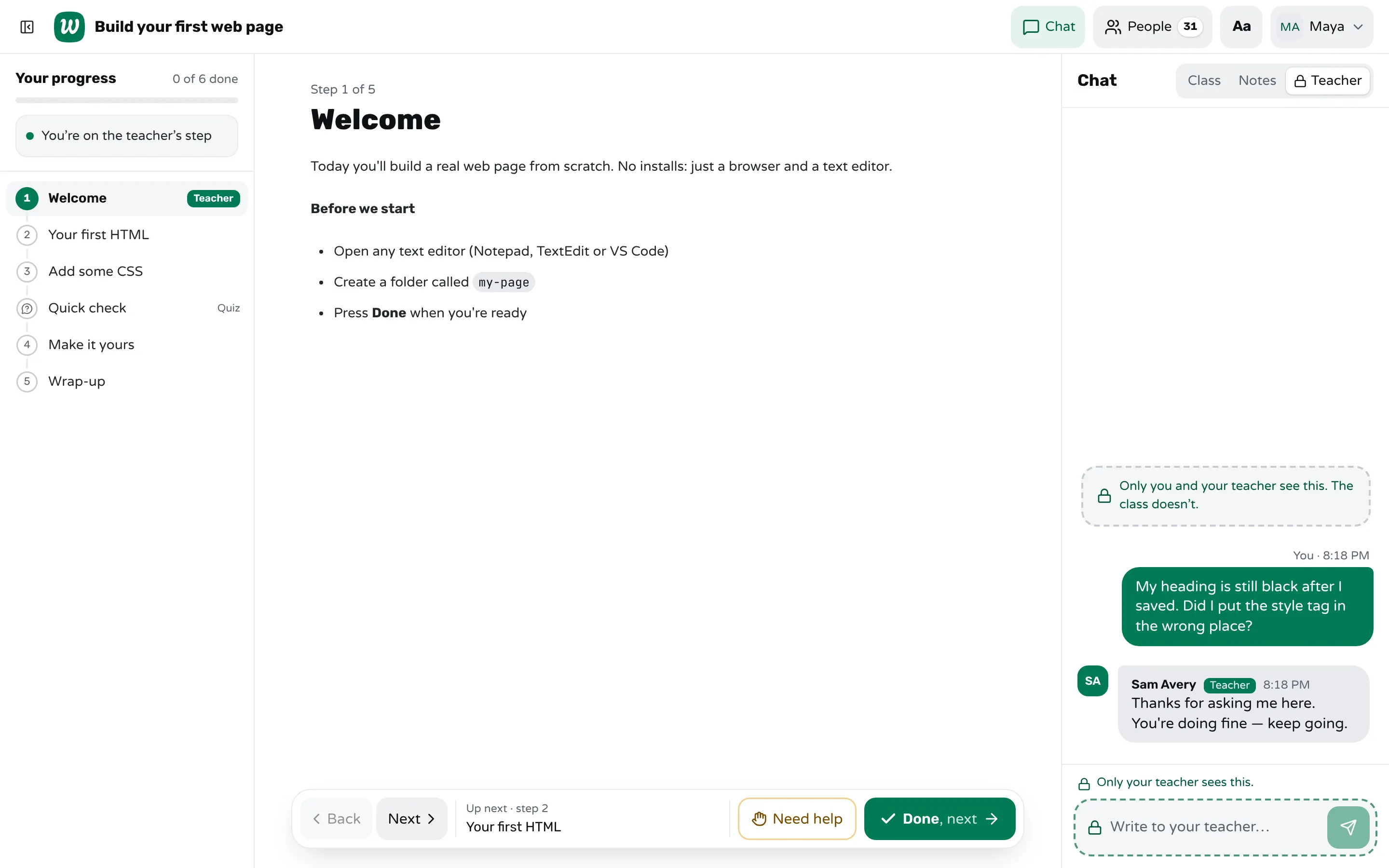
When someone is stuck, Need help sends you a request with a note if they add one, and it reaches only you. For a question they would rather not ask in front of anyone, the chat has a Teacher view: a private conversation that only the two of you see. With Look ahead on, the experienced ones can move to the next step without waiting for the room. After the class, students can keep a page with the lesson to reread later.
Sources
- Greg Wilson, Teaching Tech Together (2019): Motivation and demotivation
- The Carpentries Instructor Training: Expertise and instruction
- Slava Kalyuga, Paul Ayres, Paul Chandler and John Sweller, The expertise reversal effect (Educational Psychologist, 2003)
- John Rachal, Andragogical and pedagogical methods compared: a review of the experimental literature (ERIC, 1994)
Frequently asked questions
How do adults learn differently from children?
Less than the andragogy literature suggests: experiments haven't shown adult-specific methods teaching better. What differs is the situation. Adults bring experience, have less time, and have more at stake in looking competent in front of colleagues.
How do I handle a mixed-level group of adults?
Put a worked example and an extension problem in the same step, let the experienced ones move ahead, and help the beginners first. Don't rely on people rating their own level: many misjudge it.
How do I deal with an adult learner who dominates the session?
Give their experience a job: an extension problem, or helping a neighbour. Then keep your help in order, so the quieter people get their turn.
Why don't adults ask questions in a workshop?
Asking in front of colleagues can feel like admitting they're behind. A private way to ask, and a teacher who asks "What questions do you have?" and waits, gets more of them.
Keep reading
How to run a hands-on coding workshop
Plan short steps that each end in working code, write the code live and slowly, and keep a queue for students whose code won't run.
3 min read · 19 Oct 2026
See who's stuckHow to run a help queue in a classroom
Keep one list of who needs help, take it in order, keep each visit short, and explain a repeated problem to the whole room at once.
6 min read · 20 Oct 2026
Run a live classHow to get useful feedback at the end of a workshop
Ask before people leave, ask a few specific questions about usefulness, read the answers for patterns, and tell the next group what changed.
5 min read · 21 Oct 2026
See it with a class of 45. No sign-up.
The live demo runs the real product with a simulated class. When you're ready, start free.