OtherEN
Intro to Git — Snapshots, Branches & Sharing
 WorkshopyOfficial
10 stepsQuiz9 interactiveDiagram
gitversion controlbeginners
Used by 1 teacherBeginner
A fractions on a number line lesson: hop from 0 to place a fraction, find equivalent fractions at one point, compare and go past 1.
WorkshopyOfficial
78 lessons · used by 2 teachers
Sign in to copy it to your workspace. It’s free.
10 steps · 2 quizzes · open any step, or read it here
This fractions on a number line lesson starts with a question that looks easy: a ribbon is 1 metre long, and you want to put a mark at $\frac{3}{4}$ of it. Where does the mark go, and how do you know?
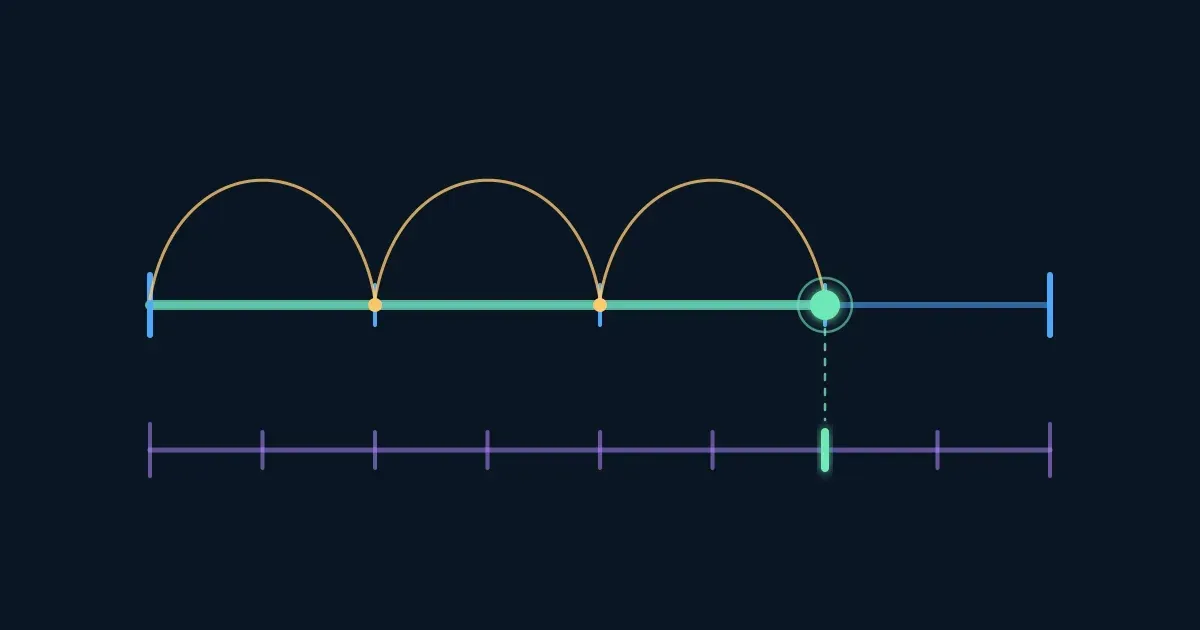
Interactive · Where does three quarters live? Watch the hops — try it in the lesson
The line from 0 to 1 was split into four equal parts, and the marker made three hops from 0. That is where $\frac{3}{4}$ lives. By the end of this lesson you can find the place of any fraction like this, and see why one point can have more than one name.
You need a browser and nothing else: every number line is in the lesson.
A number line is a ruler for numbers. Between 0 and 1 there are lots of numbers that are not whole numbers. Fractions name them.
To name them, cut the stretch from 0 to 1 into equal parts. If you cut it into 4 equal parts, each part is one quarter of the whole, $\frac{1}{4}$. Think of a running track that is 1 lap long: four equal parts are four quarters of a lap.
The parts must be the same length. If one part is longer than another, they are not quarters any more.
Try it: move the slider to cut the line into 2, 3, 4 and 8 parts. Then turn on Cut it unevenly and read what changes.
Interactive · Cut the line from 0 to 1 into equal parts — try it in the lesson
The bottom number of a fraction (the denominator) says how many equal parts the whole from 0 to 1 is cut into.
A unit fraction has 1 on top: $\frac{1}{2}$, $\frac{1}{3}$, $\frac{1}{4}$ and so on. It is one equal part, the first hop from 0.
Here is the surprise: the bigger the bottom number, the smaller the part. If you share a ribbon between 8 friends, each piece is shorter than if you share it between 3.
Try it: press the buttons from $\frac{1}{2}$ to $\frac{1}{8}$ and follow the dashed line. Which part is the longest? Which is the shortest?
Interactive · Unit fractions: more parts, smaller parts — try it in the lesson
More equal parts means each part is smaller: $\frac{1}{8}$ is less than $\frac{1}{3}$.
Now put a whole fraction on the line. To place $\frac{3}{4}$:
A fraction is a point on the line, the same way 2 is a point. The length from 0 to that point is $\frac{3}{4}$ of the way to 1.
Try it: pick Equal parts and Hops, then press Hop. Try $\frac{2}{3}$, $\frac{5}{8}$ and $\frac{4}{4}$. Keep Twice as many parts on and look at the line underneath.
Interactive · Hop from 0 to place a fraction on the number line — try it in the lesson
The bottom number says how many parts to cut, the top number says how many hops to make from 0.
Each line below is already split into equal parts. Tap the point where the fraction belongs. If you tap the wrong point, the line tells you which fraction you found instead.
Try it: place $\frac{3}{4}$, $\frac{2}{3}$ and $\frac{5}{6}$. Use Hint if you get stuck.
Interactive · Tap where each fraction belongs — try it in the lesson
Count the hops from 0, not the tick marks.
Four questions about equal parts and placing fractions.
Question 1. A line from 0 to 1 is cut into 3 parts of different lengths. Is each part $\frac{1}{3}$?
Question 2. Which part is longer?
Question 3. A line from 0 to 1 is split into 8 equal parts. A dot sits on the 5th tick after 0. Which fraction is it?
Question 4. How do you place $\frac{2}{3}$ on a number line?
A number line does not stop at 1. Keep hopping and you pass 1, then 2, then 3.
With quarters, 4 hops make $\frac{4}{4}$, which is exactly 1. The 5th hop lands on $\frac{5}{4}$: one whole and one quarter more. As a mixed number that is $1\frac{1}{4}$.
Whole numbers are fractions too: $\frac{8}{4} = 2$ and $\frac{6}{3} = 2$.
Try it: press + to hop in quarters past 1 and 2. Then switch to thirds and halves and find 2 again.
Interactive · Hop past 1: fractions bigger than a whole — try it in the lesson
When the top number is bigger than the bottom number, the fraction is past 1.
Look again at the scene from the hopping step: $\frac{3}{4}$ and $\frac{6}{8}$ landed on the same point. Fractions that sit on the same point are equivalent: they are equal, even though they look different.
Halfway along a 1-metre ribbon is $\frac{1}{2}$ of a metre. It is also $\frac{2}{4}$, $\frac{3}{6}$ and $\frac{4}{8}$ of a metre.
Try it: move the yellow guide with the slider or the arrows. Press Next shared point to jump to the points that have more than one name.
Interactive · One point, many names: equivalent fractions — try it in the lesson
Equivalent fractions are different names for the same point on the number line.
On a number line, the number farther to the right is bigger. Fractions work the same way.
Two shortcuts:
Try it: guess which fraction is bigger, then watch both land. Press Next pair for six pairs.
Interactive · Guess which fraction is bigger, then watch — try it in the lesson
Farther from 0 means bigger. Same bottom number: count the parts. Same top number: compare the size of the parts.
When the bottom numbers and the top numbers are both different, $\frac{1}{2}$ is a handy point to compare with. It is called a benchmark.
To tell if a fraction is more or less than half, find half of the bottom number:
So $\frac{5}{6}$ is bigger than $\frac{3}{8}$: one is past half, the other is not.
Try it: sort all five fractions. The yellow mark is $\frac{1}{2}$.
Interactive · Sort fractions: less than, equal to or more than one half — try it in the lesson
Half of the bottom number is the half-way point: a top number above it means more than $\frac{1}{2}$.
Answer each one, then press Check. You can type a fraction like 3/4. Hints cost nothing.
Six questions about the whole lesson.
Question 1. Where is $\frac{4}{4}$ on the number line?
Question 2. Between which two whole numbers is $\frac{7}{4}$?
Question 3. Which fractions are at the same point as $\frac{1}{2}$? (pick all that apply)
Question 4. Which is bigger: $\frac{2}{5}$ or $\frac{4}{5}$?
Question 5. Which is bigger: $\frac{1}{3}$ or $\frac{1}{6}$?
Question 6. How does $\frac{3}{8}$ compare with $\frac{1}{2}$?
Workshopy shares this lesson under CC BY 4.0. Anyone may use and change it, with credit to you. Anyone can learn it here, free. A copy in your workspace is yours to change and run live; your students never need an account.
Version 1Current
· First published
Copies are made from the current version. A copy you already have doesn’t change.
WorkshopyOfficial10 stepsQuiz9 interactiveDiagram
gitversion controlbeginners
WorkshopyOfficial16 steps2 quizzes15 interactiveDiagram
workshopyproduct touronboarding
WorkshopyOfficial10 steps2 quizzes10 interactive
data-literacystatisticsmean and median
WorkshopyOfficial9 steps2 quizzes4 interactive
geometryperimeterarea
WorkshopyOfficial10 steps2 quizzes10 interactive
mathexponential growthcompound interest

Comments
No comments yet. Be the first to say how it went.