
How to get students to ask for help
By the Workshopy teamPublished 7 min read
Students ask for help when asking costs less than staying stuck. Make it one private action they can take without speaking, while they keep working; say out loud that getting stuck is part of the lesson; and answer every request quickly and kindly, so the next one comes sooner. Then go to the students who still don't ask, because they are usually the ones who need it most.
Why students don't ask
Asking for help in front of a class costs something. You admit you're behind, you interrupt, everyone can see you, and you may wait a while for an answer. Students weigh that against the cost of staying stuck, and many decide to stay stuck.
The research says the students who avoid asking are often the ones who need help most. In a study of 516 sixth graders, Allison Ryan, Margaret Gheen and Carol Midgley found that students who doubted their own ability were more likely to avoid asking for help. The link was weaker in classrooms where teachers saw caring for students' social and emotional needs as part of their job: the teacher's manner changed how risky asking felt.
Adults are no different. When William Lammers ran focus groups with 75 college students about why they don't seek help from their instructors, the reasons included intimidation and the fear of looking foolish. What made it easier was an instructor who seemed approachable, encouraging and caring.
So "any questions?" at the end of an explanation rarely works. It asks for a public confession, at a moment you chose, in front of everyone. The fixes below change what asking costs.
Make asking one action that costs nothing
The best help signal takes one second, needs no words, and lets the student keep working while they wait.
- A sticky note or a card. Greg Wilson describes giving every learner two coloured sticky notes, one for "done" and one for "I need help", to put on their laptop. It works better than raised hands because it's discreet, so people actually use it, and they can keep typing while their flag is up.
- A cup or a coloured card on the desk, turned to red for "I need help", does the same in a room without laptops.
- A button on their screen, in a class where everyone works on a laptop.
Whatever you choose, take away the raised arm. A student holding a hand in the air can't work, and everyone in the room can see who is stuck.
Make it private
Public asking is the expensive part, so keep it between the student and you. A note on a laptop is less public than a hand, and a message only you can read is less public still.
Kitsantas and Chow asked more than 470 college students in traditional, blended and online courses how they preferred to seek help. Students in courses with an online part reported feeling less threatened about asking and sought help more, and students preferred electronic means of asking. A private channel matters most to the students who fear being seen.
Privacy also helps the student who has a question they think is stupid. Typed to the teacher alone, "where do I save the file?" costs nothing.
Say that getting stuck is part of the lesson
Students read the room for what counts as success. If the class seems to be about who finishes first, a question marks you as slow. If it's about learning to do the thing, a question is part of the work.
Stuart Karabenick studied this in large college classes, more than 1,700 students in chemistry and psychology courses. Where students felt the class emphasised understanding and improving, they were more likely to approach the teacher for help and less likely to avoid it. Where they felt it emphasised not looking incompetent, avoidance went up.
You set that tone with a few sentences, and they cost nothing:
- Before a hard step: "Most people get stuck on step 3. That's why it's here. Press for help as soon as you're stuck."
- When you make a mistake while demonstrating: say what went wrong and how you noticed. A teacher who gets an error and reads it calmly shows what to do with one.
- When someone asks: "Good, that one trips up a lot of people." Never "as I said earlier".
Don't praise speed. "Wow, Dana's already done" tells the other 29 they are behind.
Teach them how to ask
Some students don't ask because they can't say what's wrong. "It doesn't work" feels like a non-question. Give them a pattern: what I tried, what I expected, what I see instead. "I ran the cell, I expected a table, I get a red error on line 4" is easy to write and fast to answer.
A short list of reasons to pick from helps too: I get an error, I'm lost, it's too fast. A student who can't put the problem into words can still tap one, and the list tells everyone that being lost is an ordinary reason to ask.
Answer so they ask again
The first answer decides whether there's a second request. A student who asked and got a sigh, a long wait, or an answer delivered to the whole room, won't ask again soon.
- Get there fast. Use a help queue so you take requests in order and the quiet student isn't skipped.
- Thank them for asking. Especially the first time.
- Don't take the keyboard. Point at the line, ask what they expected, and let them type the fix.
- Close the loop. Before you leave, check it works, and make it easy to ask again if it breaks a minute later.
- When three people ask the same thing, explain it to the whole room without naming who asked.
Go to the ones who still don't ask
Even in a class where asking is cheap, some students won't. They sit on a step much longer than everyone else and say nothing. Don't wait for them: once most of the class is done with a step, look for who isn't, and check in with them privately. "How's step 3 going? Happy to take a look." is an invitation, not an accusation. Some will be fine and just slower. Some were stuck the whole time.
That check-in is also how a student learns that asking is safe. The next time, many ask first. How to tell which students are stuck covers reading the room for them.
How Workshopy makes asking cheap and private
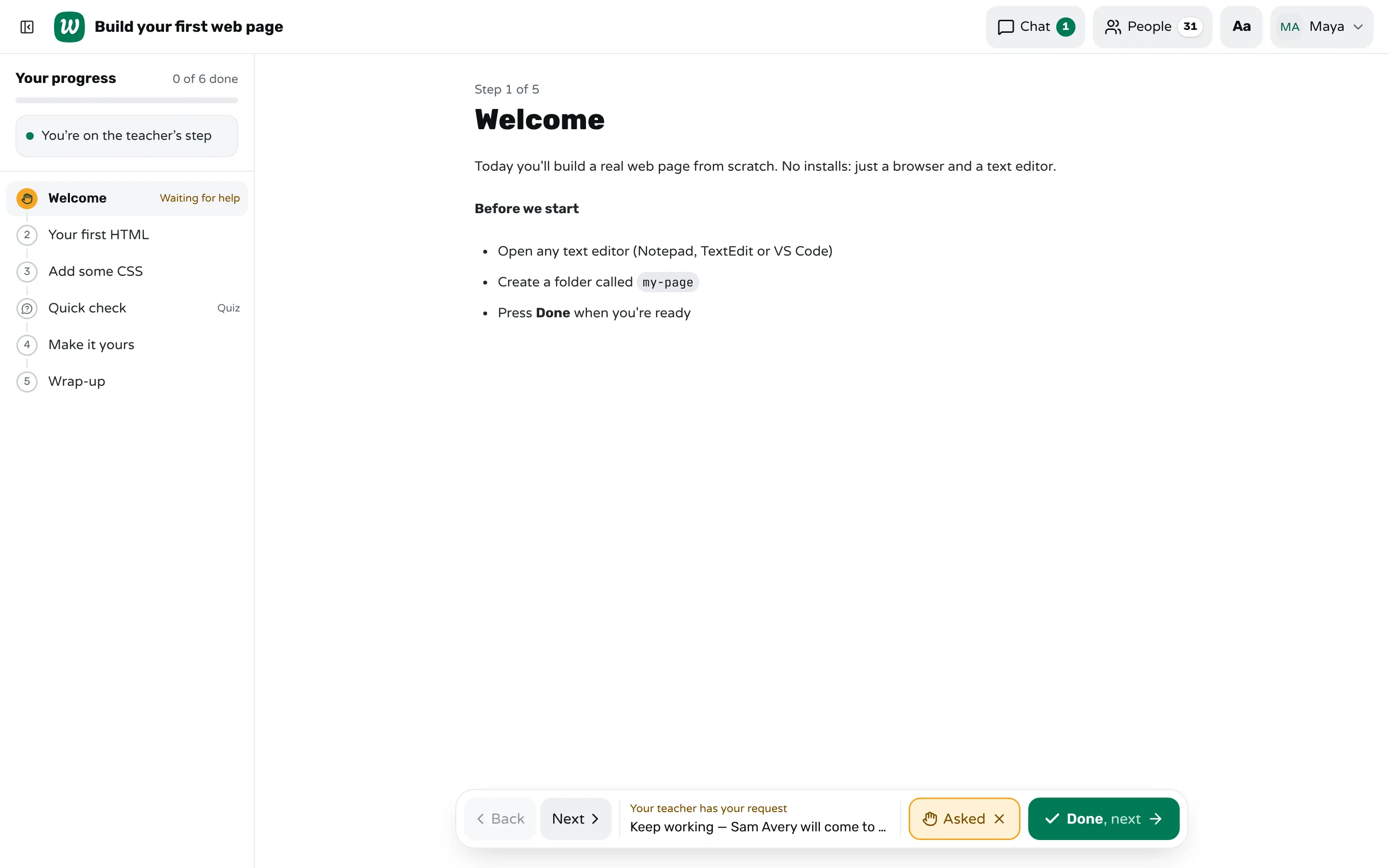
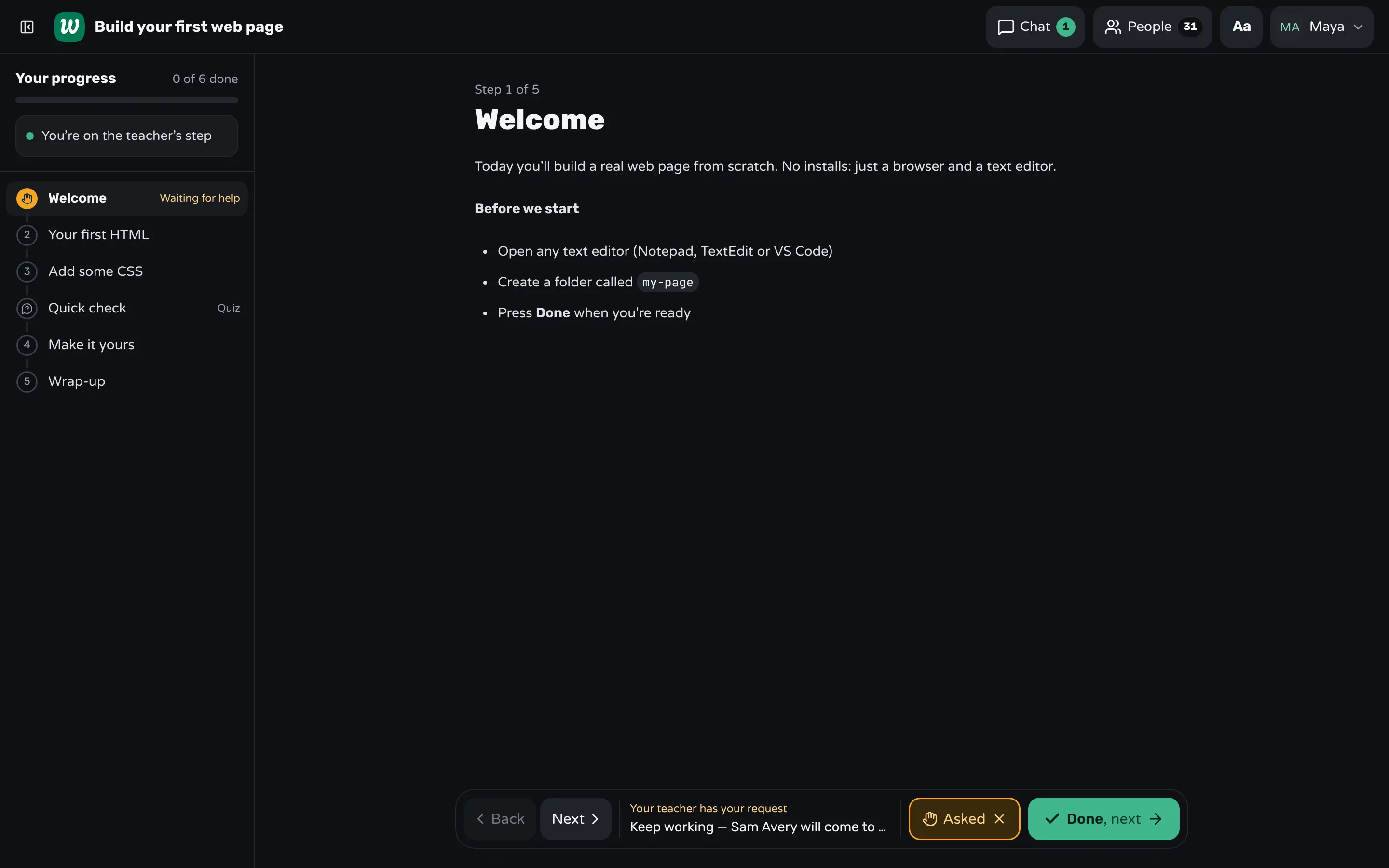
In Workshopy, every step has a Need help button beside Done on the student's screen. Pressing it opens a small form, "Ask your teacher for help", with quick reasons (I get an error, I'm lost, Too fast for me, Something else), an optional note, and the line "Private — only your teacher sees this." The student's screen then says "Your teacher has your request" and "Keep working"; the button now reads Asked, and pressing it again takes the request back if they fix it themselves.
Other students never see the request. On your screen the student's square in the room turns amber and the Help tab lists requests oldest first, each with the student's note and Resolve. When you resolve it, the student is told and gets a Still stuck button that asks again in one tap. Students can also write to you privately from the chat's Teacher view, and your answer reaches only them.
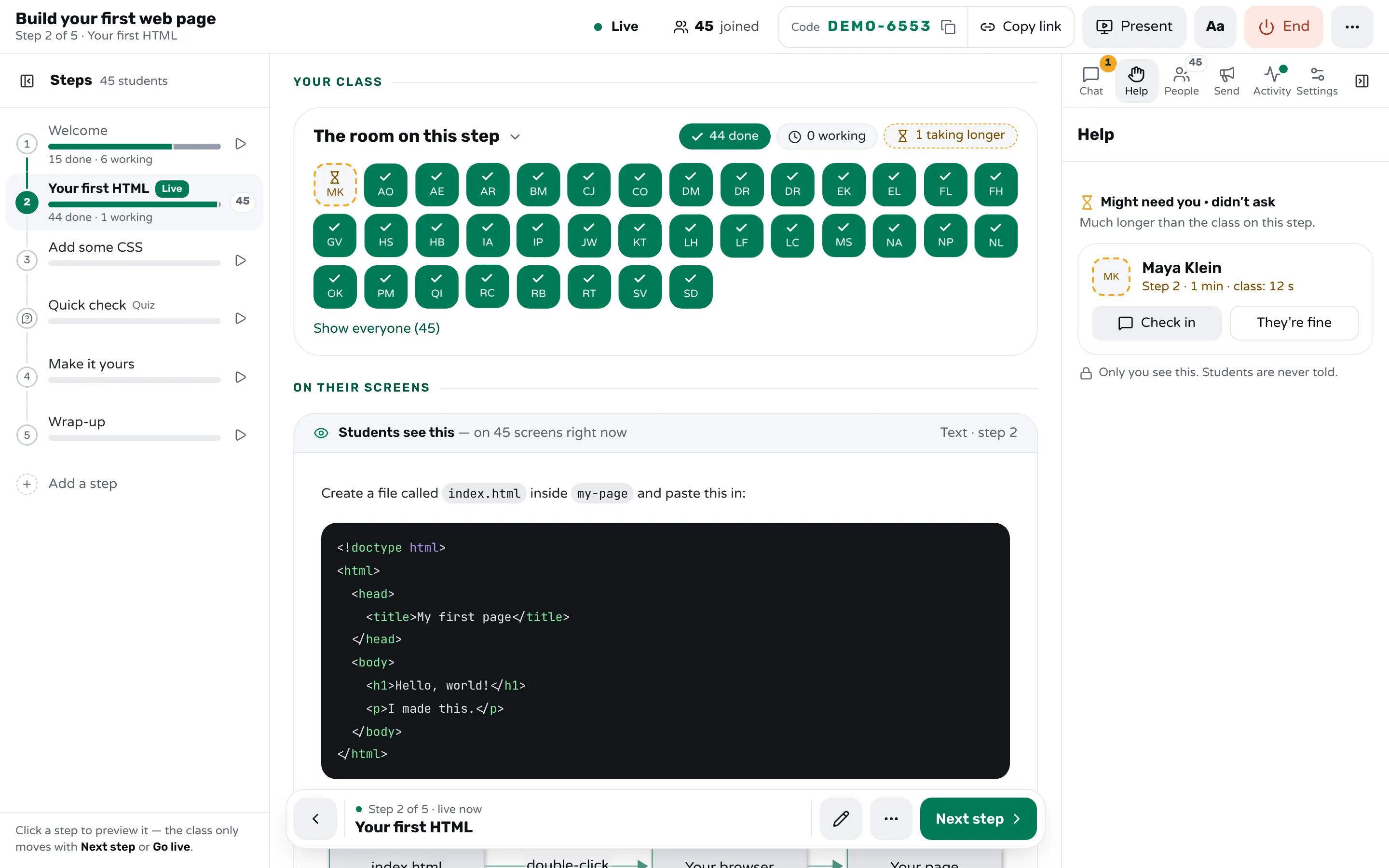
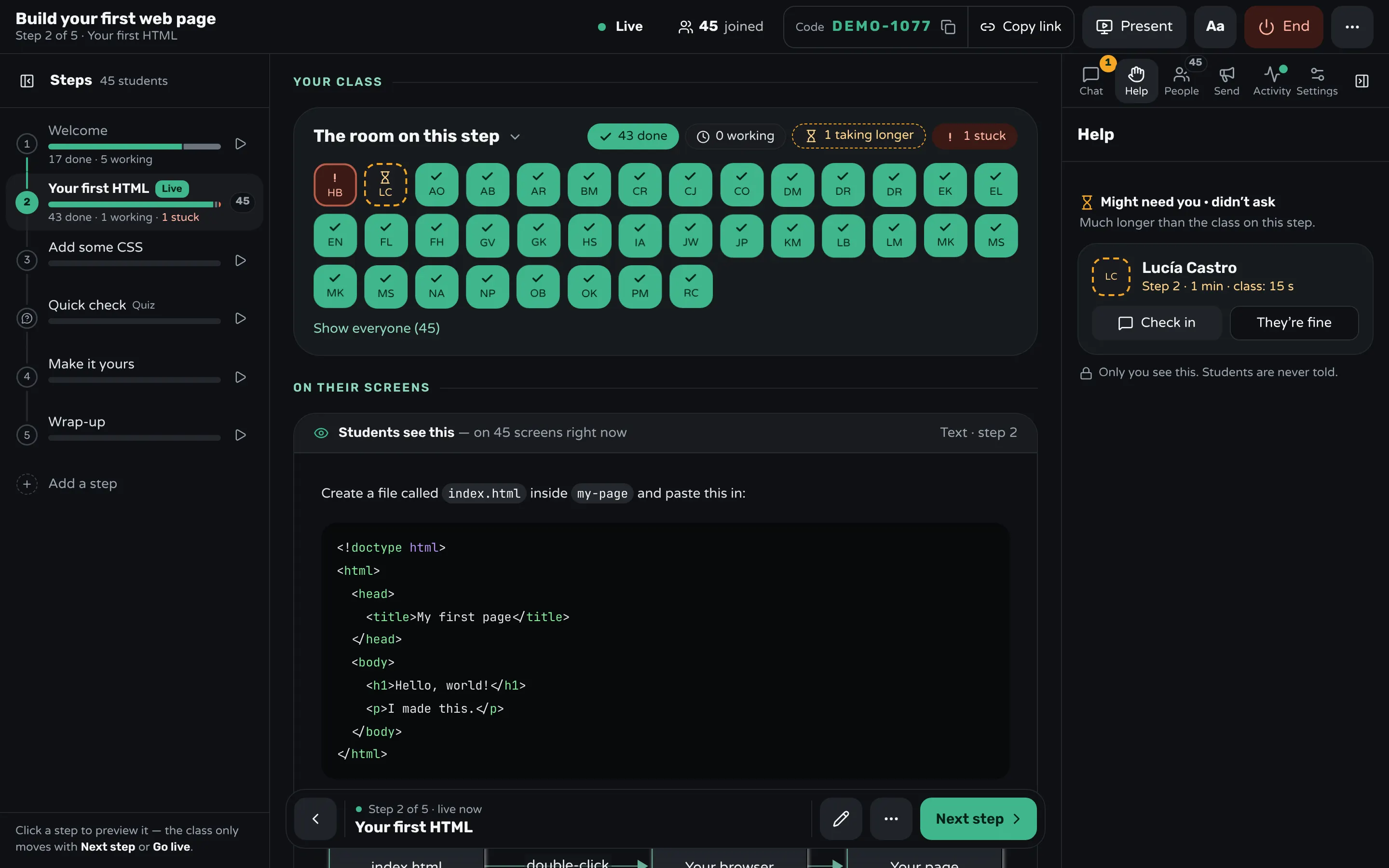
For the students who don't ask, the room marks anyone who has been on a step much longer than most of the class and hasn't asked: a dashed amber ring on their square, and a group in Help called "Might need you · didn't ask", with "Only you see this. Students are never told." Check in opens a private message to them with a suggested first line to edit before you send it, and They're fine clears the mark. After the class, the report shows, for each step, how many asked for help, how long they waited, and who took much longer without asking.
Sources
- Allison Ryan, Margaret Gheen and Carol Midgley, Why do some students avoid asking for help? (Journal of Educational Psychology, 1998)
- Stuart Karabenick, Perceived achievement goal structure and college student help seeking (Journal of Educational Psychology, 2004)
- Anastasia Kitsantas and Anthony Chow, College students' perceived threat and preference for seeking help in traditional, distributed, and distance learning environments (Computers and Education, 2007)
- William Lammers, Why won't they ask us for help? (Faculty Focus, 2022)
- Greg Wilson, Teaching Tech Together (2019): Sticky notes
Frequently asked questions
Why won't my students ask for help?
Because asking in front of the class feels riskier than staying stuck, especially for students who already doubt they can keep up. Make asking private and quick, and say out loud that getting stuck is expected.
Should I reward students for asking questions?
Thanking a student for asking and answering kindly is usually enough. Points for questions mostly reward the students who already ask; the ones who are afraid to ask need a private way to do it.
How do I help a student who never asks?
Go to them. Once most of the class has finished a step, check in privately with the ones who haven't, with an offer rather than a question about what they did wrong. Some will be fine; the rest learn that asking is safe.
Does "ask three before me" help?
It can, for small questions, and it keeps the queue short. Make it a suggestion rather than a rule, or a shy student who can't face three classmates won't ask anyone at all.
Is a help button better than raising a hand?
In a hands-on class, usually. A button or a sticky note is private, lets the student keep working while they wait, and keeps a record of who asked first, so nobody is skipped.
Keep reading
How to run a help queue in a classroom
Keep one list of who needs help, take it in order, keep each visit short, and explain a repeated problem to the whole room at once.
6 min read · 20 Oct 2026
See who's stuckHow to tell which students are stuck in a hands-on class
Stuck students rarely raise a hand. Give every step a done signal, look for who hasn't sent it, and help the right student first.
3 min read · 19 Oct 2026
Hands-on & coding workshopsHow to teach adults in a hands-on workshop
Start with something useful the same day, match the help to what each person knows, keep mistakes private, and never call anything "just".
5 min read · 21 Oct 2026
Ready-made lessons from the library
Meet Workshopy — A Live, Interactive Product Tour
A live, interactive product tour of Workshopy for new users. It runs as a real Workshopy session, so the audience experiences the product as participants while…
16 steps · ~120 min · Free
OtherIntro to Git — Snapshots, Branches & Sharing
A short, hands-on first lesson in Git for complete beginners. Students build the mental model one idea at a time — snapshots, the three areas…
10 steps · ~65 min · Free
ScienceHow Epidemics Spread — R, Curves and Herd Immunity
An interactive first look at how infectious diseases spread through a population — and what stops them.
9 steps · ~60 min · Free
Learn any of them on your own, free, or copy one and teach it live. Browse the library
See it with a class of 45. No sign-up.
The live demo runs the real product with a simulated class. When you're ready, start free.