
How to end a workshop so students remember it
By the Workshopy teamPublished 7 min read
Stop the practice ten minutes before the end, not one. Ask students to write down, without their notes, what they learned, then to do one small task from the day on their own and check it against the answer. Have each person name the first time they will use it, as "when … I will …". Then give them the lesson itself to keep, with the steps and the answers, and finish on time. Students remember the day by what they recalled at its end, not by the summary you gave them.
Why the last ten minutes decide what they keep
Most workshops end the same way: the teacher runs out of time, rushes through a summary slide, asks "any questions?" into silence, and says thank you. The summary feels useful. It mostly isn't, because the students only listened to it.
Henry Roediger and Jeffrey Karpicke tested this in 2006. Students read a short text, then either read it again or wrote down everything they could remember, without feedback. Five minutes later the re-readers did a little better. Two days later the students who had written it down recalled 68% against 54%, and a week later 56% against 42%. The re-readers were also the most confident they would remember. Recalling is harder than rereading, and that effort is what makes it stick.
A teacher's recap is rereading, done for the students. The end of a workshop is the cheapest moment to swap it for recall: everything is still fresh enough to retrieve, and nobody has left yet.
Ten minutes is enough for a two-hour class. For a full day, end each block before a break the same way, in a shorter form, and give the last close twenty to thirty minutes.
Let them recall it, not you
Ask before you tell. Three ways that work in a room of laptops:
- The closed-book list. "Close your laptop. On paper, write the three things you could now do that you couldn't this morning." Give two minutes. Then show your own three, and let them compare.
- The step from memory. "Without scrolling up: what was the command that saved a version of your file?" One question per key step, answered by everyone at once, then the answer on the screen.
- Explain it to a neighbour. Each pair takes one step of the day. One person explains it in a minute, the other says what was missing.
What makes these work is that students produce the answer before they see it. Show the right answer straight after, so a wrong memory doesn't stay. And keep it low stakes: no grades, no names on the projector. A student who can't remember something has just found out what to look at again, which is the point.
Make the last task one they do alone
In a hands-on workshop, recall means doing, not saying. During the day students worked with your example on the projector, their neighbour and the instructions on their screen. The last task is the one moment they use the skill alone, in a new small case.
Pick the core result of the day and ask for it again, from scratch, in five minutes:
- After a CSS workshop: "In a new file, make a page whose heading is green and whose text has 40 px of space around it."
- After a SQL workshop: "How many customers have no email address? Paste the number."
- After an Excel training: "In a blank cell, count the orders over 500. What do you get?"
Give the answer they can check against, so each student knows straight away whether they can do it. The ones who can't now know which step to open again, and you know who to email the next day. This is close to an exit ticket, but the aim here is the student's memory, not your planning: the task matters more than the reading of the answers.
Ask for one next step, with a when
People leave a workshop meaning to use what they learned, and most never find the moment. A plan with a time and a place helps more than a good intention. Peter Gollwitzer calls it an implementation intention: "when situation X comes, I will do Y". In a meta-analysis of 94 studies with more than 8,000 people, plans in that form helped people reach their goals much more than the goal alone (an effect of d = 0.65).
So the last question is not "what did you learn?" but "when will you first use it?". Ask each person to write one line:
- "On Monday, when I open the weekly sales file, I will replace the copy-paste totals with SUMIF."
- "Tonight, when I finish my homework page, I will push it to GitHub."
- "Next time someone asks me for a report, I will write the query myself before asking IT."
Have them write it where they will see it again: the top of their notes, a message to themselves, the first line of the file they will use. Two or three people can read theirs aloud. It takes two minutes and turns the day into a first action.
Give them the lesson to keep
What students take home decides what they can do next week. A deck of slides without the speaker is hard to learn from. Hand out the lesson as it was taught: every step, the code or the formula, the result each step should give, and the answers to the exercises.
Three things make the handout used rather than filed:
- They can redo it. The steps and the exercises, not just a summary. A student who forgot a step a week later can do it again from the page.
- It opens anywhere. A link that works on a phone, without signing up to anything.
- It says where to ask. One line with your email or the course's channel, so a question at home has somewhere to go.
Tell students during the close where it is, and open it on the projector so they see it is the same lesson.
Close on time, and close the room
The end people remember is often the last thing that happened. If that was you speeding through five extra slides while people packed, that is the workshop they remember.
- Stop the content on time. Whatever you didn't cover goes into the lesson they keep, with a line saying so. It is better than rushing it.
- Take questions during the day, not only at the end. "Any questions?" at the door gets silence, or one long question everyone else waits through. Invite them earlier, and at the end point to the line for questions.
- Say what comes next: the next session, the follow-up email, or the one thing to try this week.
- Then stop. Thank people, say goodbye, and let them leave on the minute you promised.
If you want feedback on the day as well, keep it short and separate from the recall: getting useful feedback at the end of a workshop covers it.
A ten-minute close
| Minutes | What students do |
|---|---|
| 0–2 | Laptops closed: write the three things they can now do. Compare with yours. |
| 2–7 | The last task, alone, checked against the answer. |
| 7–9 | Write one "when … I will …" line. Two or three read theirs aloud. |
| 9–10 | Where the lesson is, where to ask questions, what comes next. Thank you, and stop. |
Ending a class in Workshopy
In Workshopy the close is the lesson's last step, so it reaches every student's screen when you move the class there and nothing has to be handed out.
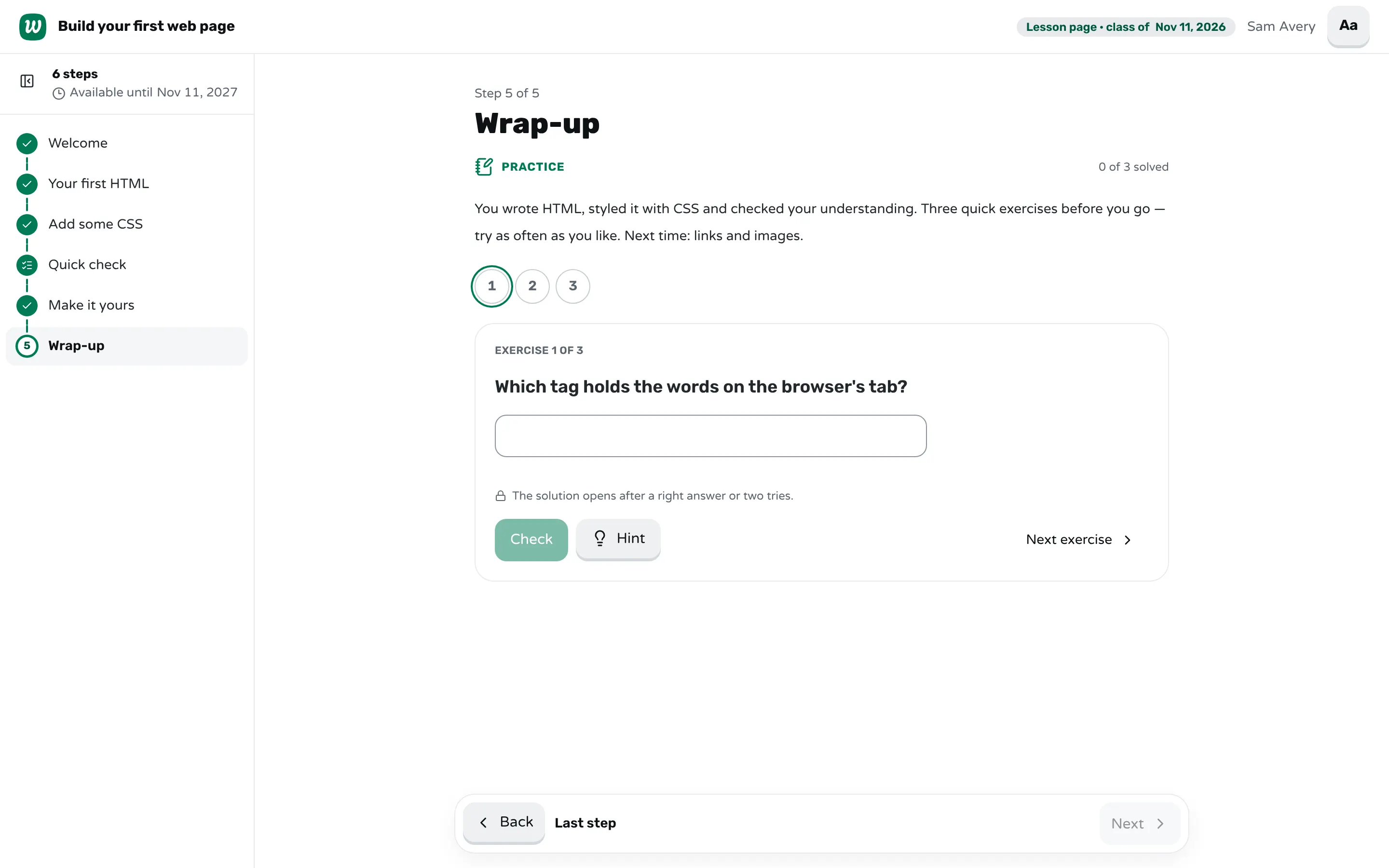
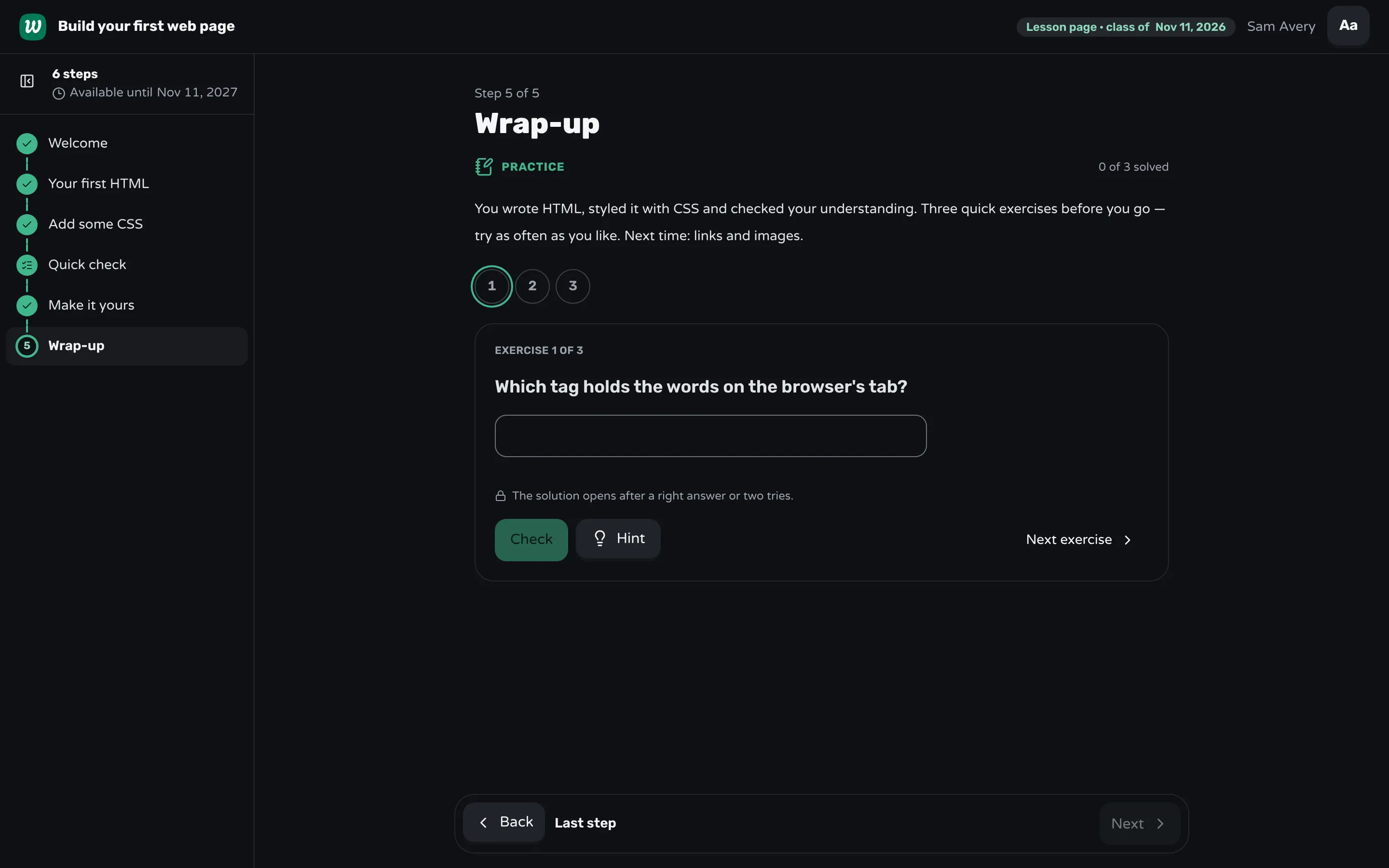
The last task as a practice step. A step that starts with #[practice] holds questions with their answers. Students type an answer, check it, try again or open a hint; nothing is graded. On your screen, marked Only you, you see who solved each question and the wrong answers the class gave most. The demo's own lesson ends this way, with a step called Wrap-up:
#[practice] Wrap-up

Three quick exercises before you go. Try as often as you like.

## Which rule turns the heading green?
- [ ] body { margin: 40px; }
- [x] h1 { color: seagreen; }
- [ ] h1 { margin: seagreen; }
mistake: h1 { margin: seagreen; } → margin is space around it; color is the text's colour.
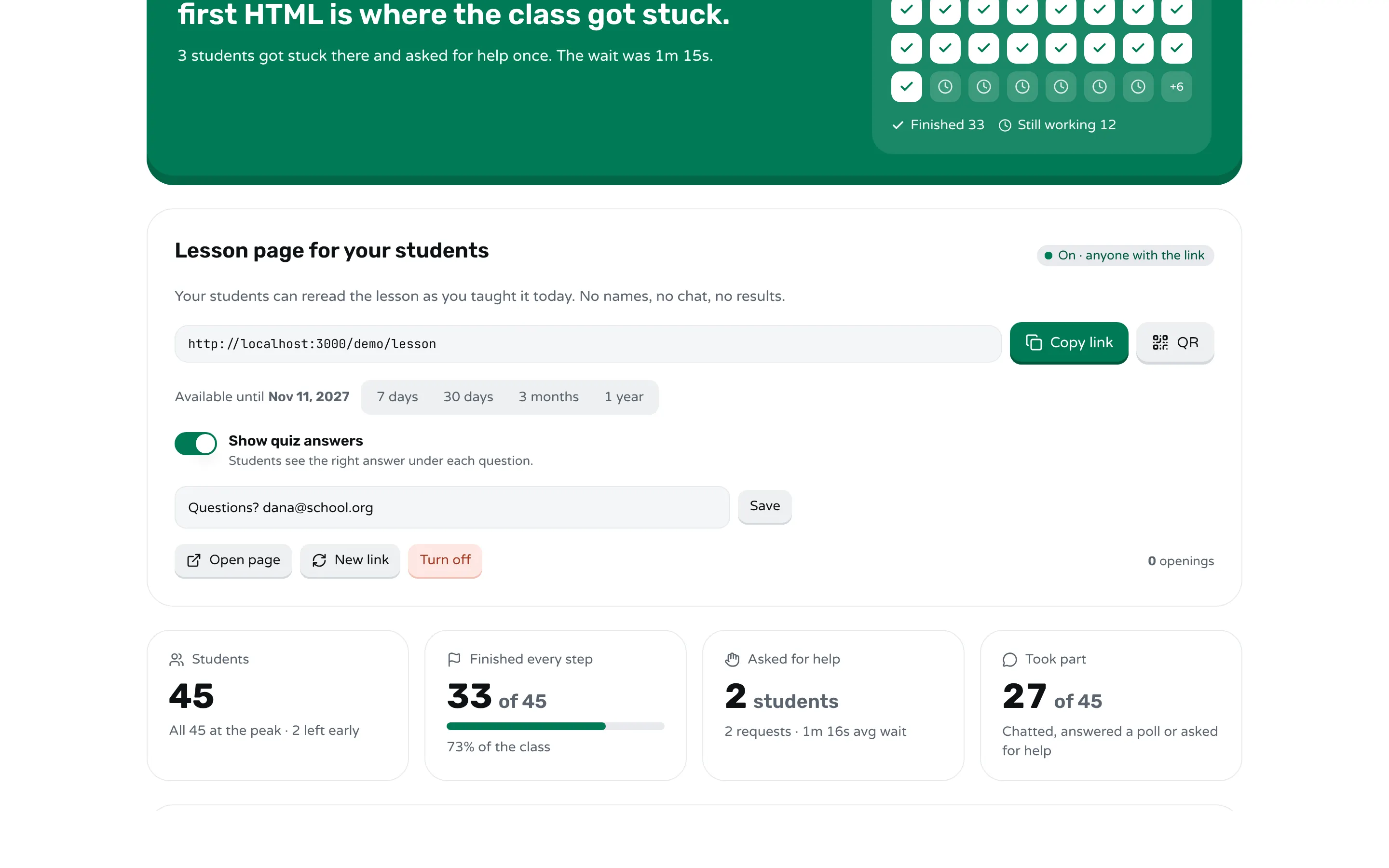
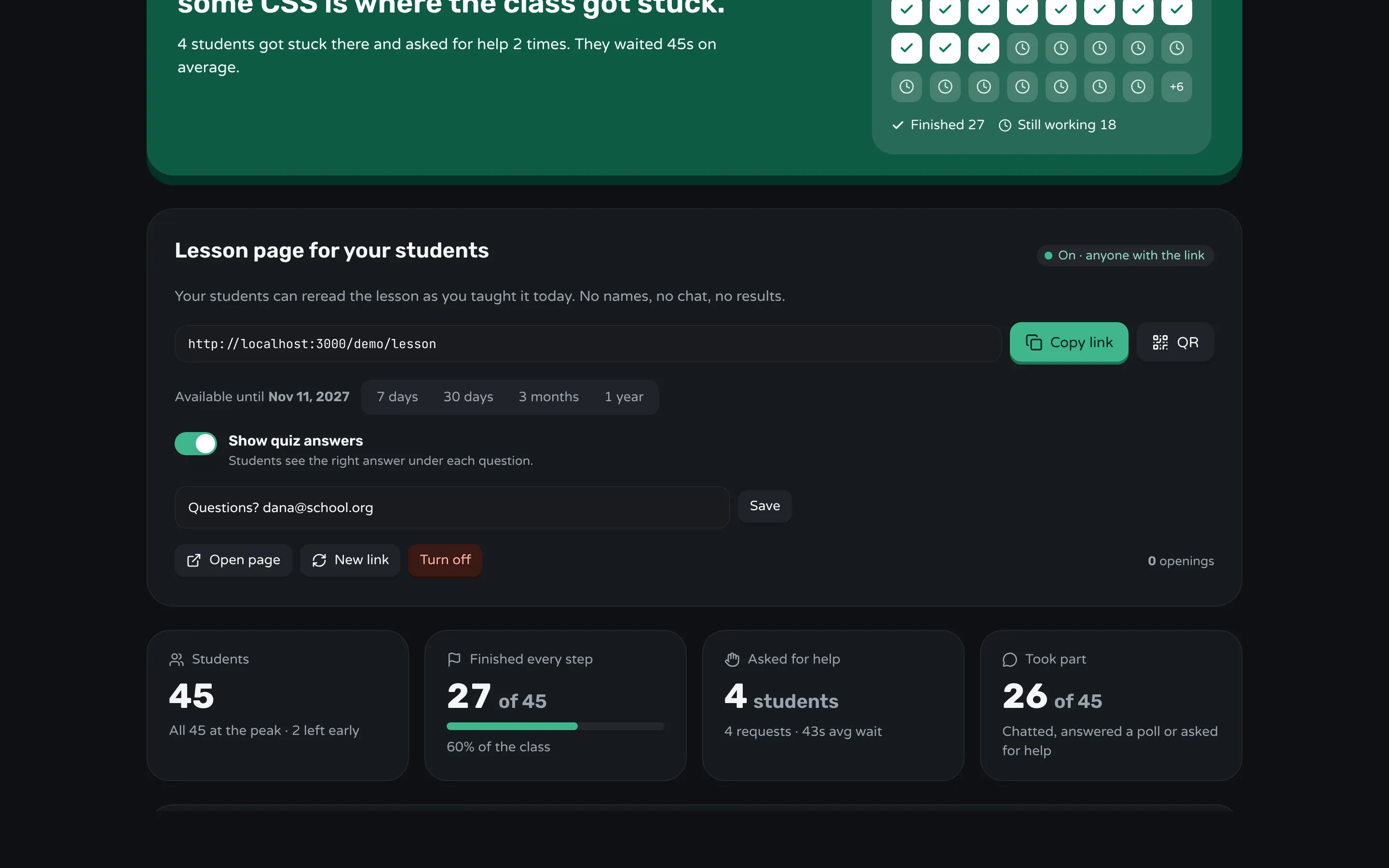
The lesson to keep. When the class ends, Workshopy makes a lesson page: the steps as you taught them, including anything you edited during the class, with no names, chat or results on it. Each student's end-of-class screen has Keep this lesson and Copy link, and the page opens on any device without an account. On the report you can copy the link, show a QR code, choose how long it stays open, add a line for questions, and turn on Show quiz answers. With the answers on, students can do the practice exercises again on the page and check each one.
The next steps can go in the class chat: ask everyone to post their "when … I will …" line, and the class reads each other's.
Sources
Frequently asked questions
How long should the end of a workshop take?
About ten minutes for a two-hour class, and twenty to thirty for a full day. In a day-long workshop, close each block before a break the same way in a few minutes.
Should I finish with a summary of the main points?
Let students make the summary first, without their notes, and show yours afterwards to compare. Recalling the day helps them remember it far more than hearing it again.
What should students take home from a workshop?
The lesson as it was taught: every step, the results each step should give, and the answers, in a form that opens on a phone without signing up. Add one line that says where to ask questions.
How do I end a workshop on a positive note?
End on something students did: the last task they solved alone, and the first thing they will do with it. Then thank them and finish on time.
What if I run out of time before the close?
Cut content, not the close. Put what you didn't cover into the lesson they keep, and still leave the last ten minutes for recall and next steps.
Keep reading
How to use exit tickets in a hands-on lesson
Ask one or two questions in the last five minutes, read them in two piles before the next class, and open that class with what they showed.
7 min read · 4 Nov 2026
Run a live classHow to get useful feedback at the end of a workshop
Ask before people leave, ask a few specific questions about usefulness, read the answers for patterns, and tell the next group what changed.
5 min read · 21 Oct 2026
Run a live classHow to measure whether a training session worked
Decide what people should be able to do, measure it during the session and with a task at the end, and check weeks later if they use it.
5 min read · 21 Oct 2026
Ready-made lessons from the library
Intro to Git — Snapshots, Branches & Sharing
A short, hands-on first lesson in Git for complete beginners. Students build the mental model one idea at a time — snapshots, the three areas…
10 steps · Free
Teacher trainingMeet Workshopy — A Live, Interactive Product Tour
A live, interactive product tour of Workshopy for new users. It runs as a real Workshopy session, so the audience experiences the product as participants while…
16 steps · Free
Teacher trainingTrain the Trainer: How to Design a Hands-On Workshop
A train the trainer workshop on designing hands-on sessions: write objectives you can see, plan an hour of talks, exercises and checks, find who's stuck.
11 steps · Free
Learn any of them on your own, free, or copy one and teach it live. Browse the library
See it with a class of 24. No sign-up.
The live demo runs the real product with a simulated class. When you're ready, start free.