OtherEN
Intro to Git — Snapshots, Branches & Sharing
 WorkshopyOfficial
10 stepsQuiz9 interactiveDiagram
gitversion controlbeginners
Used by 1 teacherBeginner
Active learning workshop for faculty: think-pair-share, peer instruction and minute papers in a 200-seat hall, the evidence charted, and a session you plan.
WorkshopyOfficial
78 lessons · used by 2 teachers
Sign in to copy it to your workspace. It’s free.
11 steps · 2 quizzes · open any step, or read it here
This active learning workshop for faculty shows university lecturers how to get every student in a large hall thinking, not only listening. You practise think-pair-share, peer instruction with ConcepTests, retrieval practice, the minute paper and jigsaw, and you plan a 50-minute session that uses them.
Active learning means students do something with an idea during class: answer, explain, compare, decide. It does not mean throwing out the lecture. Most of the strategies here take two to eight minutes and fit between the slides you already have.
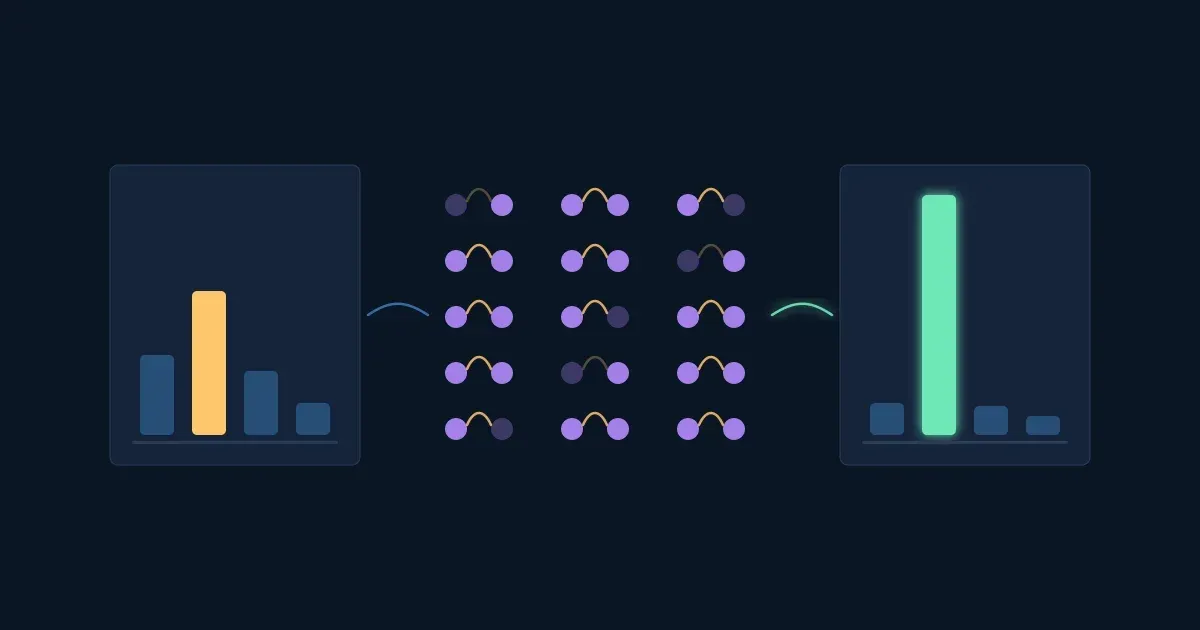
Try it: this is a peer-instruction vote in a 200-seat hall. Two hundred students have answered a conceptual question on their own. Press Talk to a neighbour, then Vote again, and watch the room change its mind.
Interactive · A ConcepTest in a 200-seat hall: vote, talk, vote again — try it in the lesson
In this workshop you'll:
It takes about 75 minutes. Bring one lecture you teach: you will plan a session for it at the end.
Takeaway: active learning is a few minutes at a time of students doing something with the idea, inside the lecture you already give.
Faculty ask for evidence before they change how they teach, and they are right to. Three studies come up in almost every discussion of active learning. Each one is in the chart below, with the numbers exactly as the paper reports them.
Try it: switch between the three studies. For each, say in one sentence what a lecturer should take from it.
Interactive · The evidence for active learning, from three studies — try it in the lesson
Two things the evidence does not say. The claim that attention collapses after ten to fifteen minutes is widely repeated, but a review of the studies behind it (Wilson and Korn, 2007, Teaching of Psychology) found little solid support for any fixed limit. And the "learning pyramid", which says people remember 10% of what they read and 90% of what they teach, has no study behind its percentages: it is a myth, and quoting it to colleagues costs you their trust. The case for active learning stands on the studies above.
Another lesson in the library, The Science of Learning, goes deeper into retrieval and spacing. Here we use them in a large hall.
Takeaway: across 225 studies, lecture-only courses failed more students; the gain comes from students working on the ideas, not from any fixed attention span.
Think-pair-share is the smallest active-learning move there is, and it works in any room. You ask a question, give everyone a minute to think and write an answer on their own, have them compare with the person beside them, then call on a few pairs to share with the hall.
Each part does a different job. Think gives every student an answer of their own before anyone speaks, so the fastest voice doesn't decide for the room. Pair gets every student to put the idea into words, which is where gaps show up. Share lets you hear what the room thinks, from a few pairs rather than the two students who always answer.
What makes a good question for it: one with more than one reasonable answer, or one where the reasoning matters more than the result. "Which of these two policies would reduce unemployment faster, and why?" works. "What is the formula for variance?" does not: there is nothing to discuss.
Try it: first press Ask the room and see how many students take part. Then run Think, Pair and Share and compare the counters.
Interactive · Ask the room, or think-pair-share: who takes part — try it in the lesson
Three habits make it work in a big hall:
Takeaway: asking the room hears the same three hands; think-pair-share gets all 200 students to say an answer and lets you sample the room.
Peer instruction, developed by Eric Mazur for large Harvard physics lectures, turns a lecture into a chain of short presentations, each followed by a conceptual multiple-choice question called a ConcepTest. As Crouch and Mazur (2001) describe it:
The first vote tells you what to do next. Across a semester of ConcepTests, Crouch and Mazur found that discussion raised the share of right answers substantially as long as 35% to 70% of students were right on the first vote, with the biggest gain at about 50%. Below that range too few students hold the idea to pass it on; above it most of the room already has it.
A good ConcepTest asks about a concept, not a calculation, and its wrong options are the mistakes students really make. You find those in last year's exam scripts and office hours.
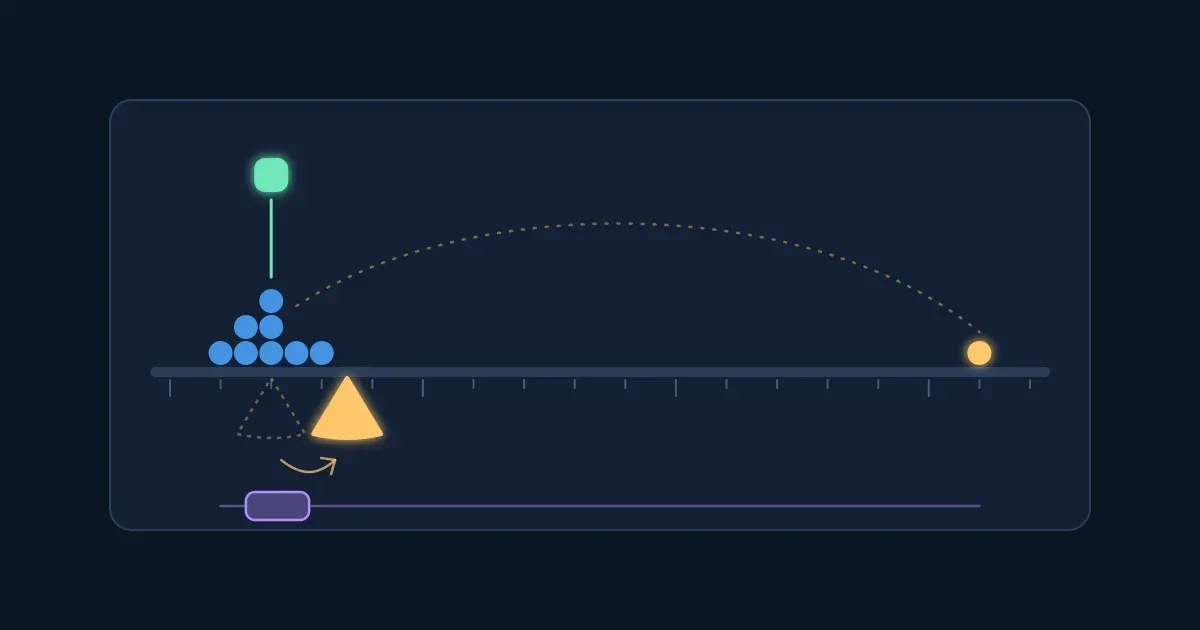
Try it: move the slider to the share of the room that was right on the first vote, and read what to do next.
Interactive · Read the first vote: what to do next — try it in the lesson
You don't need clickers. Coloured cards (A to D on four colours, printed once and kept in the hall) or a free phone poll work, and fingers held up against the chest are enough for a quick read. What you need is the individual vote before the talk: without it, the confident students set the answer and the others agree.
Takeaway: vote alone, discuss, vote again — and let the first vote decide whether you discuss, reteach or move on.
In a real lecture you get the first vote and about five seconds to decide. This step is practice at that decision, with five votes from large first-year courses.
For each vote, look at the share who chose the right answer (marked) and how the wrong answers are spread. Then choose what you do next. A vote split between two options is worth a second look: it usually means two ideas are competing in the room, which is exactly what a discussion settles.
Try it: decide all five votes. If you are unsure, open the hint.
Interactive · Five first votes: decide what to do next — try it in the lesson
Two things to watch for when you run this for real. Don't show the live histogram during the first vote: students drift toward the leading answer. And show it, if you show it at all, only after the second vote, when it becomes a picture of what the discussion did.
Takeaway: the share who were right on the first vote, and where the wrong answers sit, tell you whether to discuss, reteach or move on.
Four questions on the first half. Answer on your own first, as your students would.
Question 1. In Freeman and colleagues' 2014 meta-analysis, how did failure rates compare?
Question 2. Why does think-pair-share start with time to think alone?
Question 3. On a ConcepTest, 52% of the hall chose the right answer on the first vote. What do you do?
Question 4. A colleague quotes "students remember 10% of what they read and 90% of what they teach". What is the best reply?
Retrieval practice is asking students to bring an idea back from memory instead of reading it again. Roediger and Karpicke's experiment, in the chart two steps back, is one of many: being tested on material made it stick better a week later than rereading it. In a lecture, the cheapest way to use this is to open with three short questions, answered on paper or in a poll, before you start anything new.
Three choices make an opener work:
Try it: you teach a first-year statistics course of 220 students. Build today's opener from the question bank.
Interactive · Build a three-question retrieval opener — try it in the lesson
In a 200-seat hall, the opener has a second job: it settles the room. Put the questions on the screen as students arrive, start the clock at the hour, and take the answers by poll or a show of cards. Spend one minute on the question most of them missed.
Takeaway: open with three ungraded questions from memory, old and new, and let the answers tell you what to revisit.
The minute paper and the muddiest point are two of the classroom assessment techniques Angelo and Cross collected in Classroom Assessment Techniques (1993). In the last two or three minutes of a lecture, students answer one or two questions on a slip of paper or a phone form:
They take two minutes of class time and give you something no exam does: what the room found hard, while you can still fix it. The work is in reading them. With 200 slips you don't answer each one; you sort them into a few themes, count, and open the next lecture with the biggest one.
Try it: twelve muddiest-point responses from a statistics lecture on sampling. Put each in its theme, then decide what the next lecture opens with.
Interactive · Sort twelve muddiest-point responses into themes — try it in the lesson
Closing the loop is what makes students keep writing honest answers. Start the next lecture by naming what the slips said ("Forty of you asked about…"), and answer it. With a phone form, the slips arrive sorted by time and you can read a few hundred in fifteen minutes.
Takeaway: two minutes at the end of a lecture tells you what the room found hardest; sort, count, and open the next lecture with it.
A jigsaw, first used by Elliot Aronson's team in 1971, splits a task into parts and makes every student responsible for teaching one. It suits a case study, a reading with several sections, or a problem with several sides.
It works because nobody can sit back: the home group is missing a piece without you. In a fixed-seat hall, use rows. Students with the same part sit in the same rows for the expert phase, then turn to the row behind for the home phase.
Try it: switch between the two phases and watch the groups re-form. Then set your own class size and the number of parts, and read the numbers.
Interactive · Jigsaw: from expert groups to home groups — try it in the lesson
When the class size doesn't divide evenly, the leftover students join home groups as a second expert on their part; the "+" in the numbers shows how many. Give the expert phase a written product (three points to teach, one example), and give the home group a task that needs every part to finish.
Takeaway: in a jigsaw every student studies one part with other experts, then teaches it in a group that needs every part.
A large-class activity fails most often on arithmetic: too many groups to hear from, or more minutes than the lecture has. Work out each one, then check. A hint costs nothing.
Every lecturer who starts with active learning meets resistance, and it comes from two sides.
From students. Deslauriers and colleagues (2019, PNAS) taught large introductory physics classes at Harvard in two ways, with the same content and handouts and students assigned at random: active instruction, and polished lectures by experienced, highly rated lecturers. Students in the active classes learned more, but felt they had learned less. The researchers' explanation: students took the extra effort of active learning as a sign that they were learning badly. Their advice is to address this early in the semester, before the feeling sets in.
From colleagues and yourself. The worry is almost always coverage: if class time goes to activities, the syllabus won't fit. The usual answer is to move first exposure (the definitions, the worked example) into a short reading or video before class, and spend class time on what students get wrong.
Try it: four things you will hear. For each, choose the best response.
Interactive · Four objections, and what to say — try it in the lesson
A sentence that works on the first day: "In this course you will do some of the work in the lecture, not only after it. It will sometimes feel harder than listening. That feeling is what learning feels like, and the research on large classes shows it."
Takeaway: students who feel they learn less in an active class often learn more; tell them why early, and move first exposure out of the room to keep the coverage.
Now put the pieces together for one lecture of your own. A plan that works in most courses alternates: a short stretch of lecturing, then something students do with it, then the next stretch. The activity after each stretch is where you find out whether it landed.
Three rules of thumb keep a plan honest. They are design habits, not measured limits:
Try it: build a 50-minute session from the blocks. Tap a block to add it; remove one from the list if you change your mind.
Interactive · Build a 50-minute active lecture — try it in the lesson
Now write the plan for your own lecture: the three stretches of content you must teach, the question you will ask after each, and the muddiest-point question at the end. Bring the vote results and the slips to your next workshop, or to a colleague: what students got wrong is the best guide to what to change.
Takeaway: alternate short stretches of lecturing with something students do, open with retrieval and close with a minute paper.
Six questions on the whole workshop.
Question 1. In peer instruction, what comes right after students discuss the ConcepTest with their neighbours?
Question 2. What did Deslauriers and colleagues (2019) find in large Harvard physics classes?
Question 3. Which questions make a good three-question retrieval opener? (pick all that apply)
Question 4. Twelve muddiest-point slips: five about one topic, four about another, three about a third. What do you do next lecture?
Question 5. In a jigsaw with 5 parts, what does a home group look like?
Question 6. In Roediger and Karpicke's 2006 experiment, what happened after a week?
Workshopy shares this lesson under CC BY 4.0. Anyone may use and change it, with credit to you. Anyone can learn it here, free. A copy in your workspace is yours to change and run live; your students never need an account.
Version 1Current
· First published
Copies are made from the current version. A copy you already have doesn’t change.
WorkshopyOfficial10 stepsQuiz9 interactiveDiagram
gitversion controlbeginners
WorkshopyOfficial16 steps2 quizzes15 interactiveDiagram
workshopyproduct touronboarding
WorkshopyOfficial10 steps2 quizzes10 interactive
data-literacystatisticsmean and median
WorkshopyOfficial10 steps2 quizzes9 interactive
ai-teachersformative assessmenthinge questions
WorkshopyOfficial10 steps2 quizzes8 interactive
trainersfacilitationworkshops
WorkshopyOfficial11 steps2 quizzes10 interactive
trainerstrain the trainerworkshop design
Comments
No comments yet. Be the first to say how it went.